
UPS, FedEx, and USPS each dominate different corners of the shipping market. Pick the wrong one and you overpay. Pick the right one and your package arrives on time, tracked precisely, for the lowest possible cost.
This complete guide breaks down every important factor so you can choose the right carrier for your needs, or understand what to expect from your current shipment.
If you're tracking a package right now, you can track it on ParcelsZen regardless of which carrier is handling it.
Overview of Each Carrier
UPS (United Parcel Service)
UPS was founded in Seattle in 1907 and serves more than 200 countries and territories. It reported $88.7 billion in revenue for 2025.
UPS operates its own aircraft fleet and runs a ground network across the US.
FedEx (Federal Express)
FedEx was founded in 1971 and pioneered overnight delivery. It is synonymous with fast, time-guaranteed shipping and remains the leader in express delivery. FedEx operates one of the world's largest cargo airline fleets and is particularly strong in international express shipping.
USPS (United States Postal Service)
USPS is the independent federal postal service of the United States and serves nearly 169 million addresses. USPS reaches every US address six days a week, making it uniquely capable for residential deliveries, especially in rural areas.
It is generally the most affordable option for small, lightweight packages.
Speed Comparison
For domestic shipping within the United States, here's how the carriers compare:
| Service Level | UPS | FedEx | USPS |
|---|---|---|---|
| Overnight | Next Day Air | FedEx Overnight ⭐ | Priority Mail Express |
| 2-Day | 2nd Day Air | FedEx 2Day | Priority Mail |
| Ground (3-7 days) | UPS Ground | FedEx Ground | USPS Ground Advantage |
| Best For Speed | Business shipping | Urgent express ✓ | Affordable 2-3 day |
📦 UPS
✈️ FedEx
🇺🇸 USPS
Winner for Speed: FedEx wins on speed for urgent shipments. FedEx Overnight, 2Day, and Express Saver are the industry benchmark for guaranteed express delivery.
Price Comparison
Pricing depends heavily on package size, weight, distance, and service level. Here's the general breakdown:
Small, Lightweight Packages (Under 1 lb)
USPS is almost always the cheapest option. In July 2023 USPS retired First-Class Package Service and replaced it with USPS Ground Advantage, so any guide still quoting First-Class Package rates describes a service that no longer exists. At published list rates, a 1 lb parcel measuring 9×6×3 inches costs $9.37 with USPS to Boston and $12.05 to Los Angeles, against roughly $23 to $29 with UPS or FedEx over the same routes. That is a gap UPS and FedEx cannot close on list pricing.
Medium Packages (1-10 lbs)
On published rates USPS Ground Advantage still costs less than half of UPS Ground or FedEx Ground at this weight. A 5 lb box measuring 12×10×8 inches from New York to Los Angeles works out at $16.61 with USPS Ground Advantage, $36.02 with FedEx Ground and $36.25 with UPS Ground. Compare rates for your specific shipment, because zone and box shape both move the number.
Heavy Packages (Over 10 lbs)
The received wisdom is that UPS and FedEx overtake USPS as weight climbs. On list rates that did not hold in our comparison: a 15 lb parcel to Los Angeles came out at $28.45 with USPS against $57.51 with UPS and $57.89 with FedEx. Where UPS and FedEx genuinely win is with negotiated business accounts, which routinely price far below the published card, and above the 70 lb USPS ceiling where the comparison ends entirely.
The same four parcels, side by side
All figures are each carrier's published list rates for residential delivery from New York on its cheapest ground service, computed on 30 July 2026, before negotiated discounts. List rates change at least once a year, usually in January, so check current rates before you ship.
| Parcel | USPS | UPS | FedEx |
|---|---|---|---|
| 1 lb, 9×6×3 in, to Boston (Zone 4) | $9.37 ✓ | $23.81 | $23.47 |
| 1 lb, 9×6×3 in, to Los Angeles (Zone 8) | $12.05 ✓ | $29.16 | $28.73 |
| 5 lb, 12×10×8 in, to Los Angeles | $16.61 ✓ | $36.25 | $36.02 |
| 15 lb, 18×14×12 in, to Los Angeles | $28.45 ✓ | $57.51 | $57.89 |
🏤 USPS Ground Advantage
📦 UPS Ground
✈️ FedEx Ground
Two things stand out. The USPS advantage holds at every weight tested rather than disappearing as parcels get heavier, and UPS and FedEx track each other within a dollar at every point, because they price against each other rather than against the postal service.
Dimensional weight: the hidden price difference
Carriers bill on whichever is greater, actual weight or dimensional weight, and they do not use the same formula. USPS divides by 166 on parcels over one cubic foot, while UPS (daily rates) and FedEx divide by 139. A smaller divisor produces a larger billable weight, so the same box costs more at UPS and FedEx before any rate is applied.
The effect is invisible on small dense parcels and severe on light bulky ones. That 5 lb box measuring 12×10×8 inches bills as 5 lbs at USPS and 7 lbs at UPS and FedEx. Push it to a 2 lb parcel in a 24×18×16 inch box, the shape a pillow or a lampshade produces, and it bills as 42 lbs at USPS and 50 lbs at UPS and FedEx. Eight extra billable pounds on an item that weighs two.
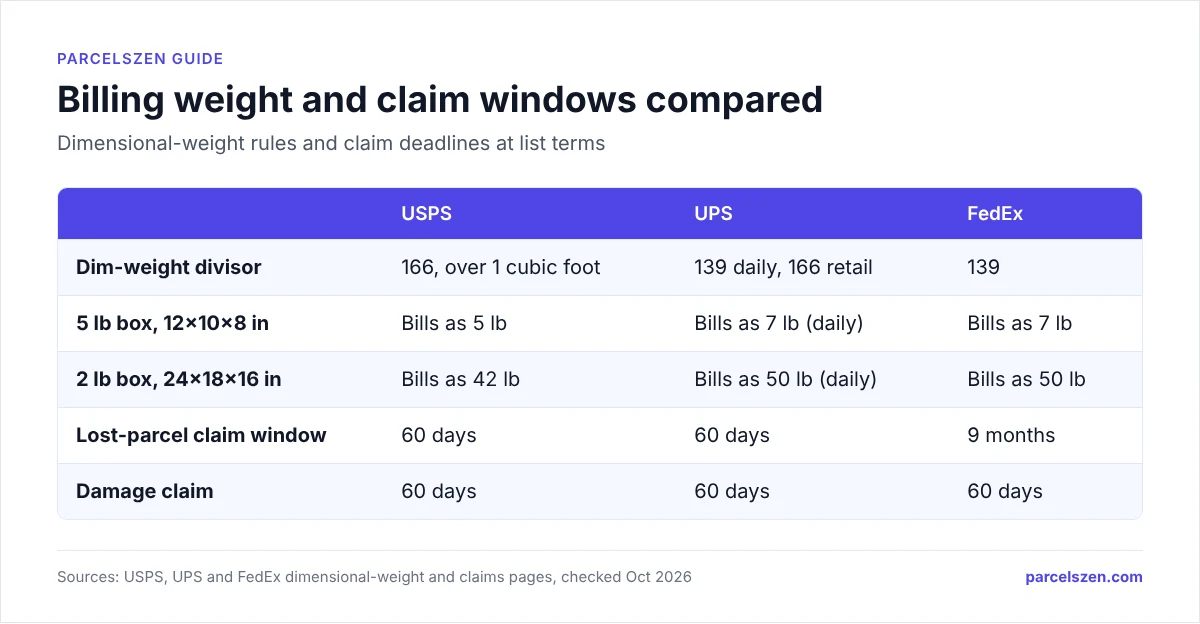
Measure the box, not just the contents. A parcel whose dimensional weight exceeds its actual weight is priced on air, and the carrier with the larger divisor wins. That is USPS at 166 against 139 for FedEx and UPS daily rates.
For packages over 70 lbs, UPS and FedEx have specialized freight services that USPS cannot match.
Tracking Capabilities
All three carriers offer real-time tracking, but the detail level varies significantly:
| Feature | UPS | FedEx | USPS |
|---|---|---|---|
| Scan Detail Level | ★★★★★ | ★★★★☆ | ★★★☆☆ |
| Delivery Photo | |||
| Package Redirect | |||
| Delivery Management App | UPS My Choice | FedEx Delivery Manager | Informed Delivery |
📦 UPS
✈️ FedEx
🇺🇸 USPS
Winner for Tracking: UPS has arguably the best tracking system, providing detailed scan-by-scan updates, proactive delivery alerts, and accurate ETAs.
Track Your Package Now
Enter any tracking number to get updates from UPS, FedEx, USPS, and 1000+ other carriers.
Track PackageReliability and Claims
FedEx offers a money-back guarantee, effective 12 February 2026, on its US overnight services and FedEx 2Day A.M., and on FedEx International First and International Priority services; the guarantee stays suspended on its other services, including FedEx Ground.
UPS is very reliable for ground shipping with strong claims processes for lost or damaged packages. Their business-focused approach means excellent service for B2B shipments.
USPS includes up to $100 of insurance on most Priority Mail shipments and $100 on Ground Advantage. USPS says a decision on most claims usually comes within 5 to 10 days, and UPS says a claim that needs no extra investigation is typically resolved in 8 to 10 business days.
| Claims | UPS | FedEx | USPS |
|---|---|---|---|
| Lost parcel deadline | 60 days | 9 months | 60 days |
| Damage deadline | 60 days | 60 days | 60 days |
| Included liability | $100 | $100 | $100 |
| Who normally files | The shipper | Either party | Either party |
📦 UPS
✈️ FedEx
🏤 USPS
FedEx allows nine months to file a lost-parcel claim against 60 days at both UPS and USPS. That is the largest single difference between the three on anything measurable, and it goes unmentioned in most comparisons. Damage is a different matter: all three close at 60 days, so a parcel that arrives broken runs on a much shorter clock than one that never arrives at all.
All three include $100 of liability without extra declared value, so a $400 laptop shipped uninsured returns $100 whichever carrier lost it. On UPS the shipper normally holds the contract, which means that if you bought from a store, the store has to file and you have to chase the store. Deadlines and caps for the major carriers are in our lost package claim guide.
Which Carrier Should You Use?
Choose UPS When:
- You have a negotiated business account that prices heavy parcels below the published rates
- You need reliable ground delivery with strong tracking
- You're sending business-to-business shipments
- Tracking detail and delivery management are important
Choose FedEx When:
- Speed is critical and you need guaranteed overnight or 2-day delivery
- You're shipping internationally and need the fastest possible transit time
- You need time-guaranteed delivery for important documents or packages
Choose USPS When:
- You're shipping small or lightweight packages under 5 lbs
- You're sending to a rural or hard-to-reach address
- You want the most affordable option for everyday residential deliveries
- Budget is more important than speed
For international packages from AliExpress, Temu, or other overseas sellers, the carrier is typically chosen by the seller. Most affordable international options use China Post, ePacket, or Yanwen for the origin leg, then hand off to USPS for final delivery in the United States.
Frequently Asked Questions
Final Verdict
On published rates, USPS Ground Advantage was the cheapest at every weight we priced, from 1 to 15 lb. Pay for UPS or FedEx when you need a guaranteed overnight or 2-day time, when a parcel is over the 70 lb USPS limit, or when your business account has negotiated rates below the published card.
For most everyday consumers receiving packages from online stores, you won't choose the carrier. The seller will. Understanding the differences helps you set realistic expectations for delivery times and know who to contact if something goes wrong.
The bottom line:
- Best for Speed: FedEx
- Best for Price (small packages): USPS
- Best for Tracking: UPS
- Best for Rural Areas: USPS
- Best for Heavy Packages: USPS on published rates up to 70 lb; UPS or FedEx with negotiated rates or above 70 lb
Sources
Official pages this guide relies on, checked in October 2026.
- Corporate Fact Sheet (UPS)
- Introducing USPS Ground Advantage (USPS Newsroom)
- How to Measure a Package (transcript) (USPS)
- Shipping Dimensions and Weight (UPS)
- What is Dimensional Weight? (FedEx)
- File a Claim (FedEx)
- Domestic Claims - The Basics (USPS)