
A 'lost' package feels urgent. But most 'missing' items are not missing at all. They are behind a planter, at a neighbor's door, or still processing at a facility. Work through the checklist before filing anything, and you'll avoid a lot of wasted calls.
This step-by-step guide walks you through exactly what to do from the moment you suspect your package is missing.
Enter your tracking number on ParcelsZen to see the latest available status before taking any action.
Step 1: Confirm the Package Is Actually Lost
First, verify these things before concluding the package is lost:
- Check tracking one more time on ParcelsZen. Has it been delivered somewhere unexpected? Look for 'Left at neighbor' or 'Package left at mail room'
- Check all possible delivery locations: front door, back door, mailbox, package locker, with a building concierge, behind something in the yard
- Check with all family members or roommates who might have received the package
- For USPS packages, check your mailbox even if the item seems too big, because carriers sometimes fold soft goods into mailboxes
A parcel is not lost because it is late. It is lost when it has stopped moving. The distinction matters because carriers apply it too: a parcel that keeps scanning counts as delayed, and even a parcel that has stopped scanning cannot go to a loss claim until the carrier's minimum wait has passed, such as 15 days from mailing for USPS Priority Mail and USPS Ground Advantage.
Look at the last scan, not the estimated date. A parcel scanned into a facility four days ago and never scanned out has demonstrably arrived somewhere and stopped, which is the pattern that concerns carriers. A parcel showing steady movement two days behind schedule is simply running late.
Silence since dispatch is a different case again. If nothing has scanned since the label was created, the parcel may never have been handed over, and that is a seller problem rather than a carrier one. No carrier will investigate a shipment it cannot prove it received.
Step 2: Check the Estimated Delivery Window
Make sure the delivery window has actually passed. Economy shipping windows are wide, so a package that says '15-25 business days' has until day 25 before it's even technically late.
The delivery estimate is a forecast, not a commitment, and it is the wrong thing to measure against. Standard services carry no guarantee at all, so a parcel arriving four days late has not breached anything and no compensation follows from lateness alone.
Use the service thresholds instead. Ground services scan infrequently by design, so two or three quiet days mid-journey is ordinary. Express services scan several times a day, so a full day of silence on one of those is genuinely unusual. Judge the gap against what your service normally produces rather than against the promised date.
Add the weekend and any holiday before deciding. UPS does not pick up or deliver on Sundays, so a UPS parcel sent on a Friday often shows no new scan until Monday. USPS delivers Priority Mail Express on Sundays in many major markets for an extra fee, and FedEx Home Delivery delivers to most homes on Sundays.
Step 3: Contact the Seller First
In most cases, the seller, not the carrier, is your first point of contact for a lost package. This is because the seller purchased the shipping service and has the carrier account relationship.
Contact them via email, platform message (AliExpress, eBay, Etsy, Amazon), or their website. Tell them:
- The order number and tracking number
- What the tracking shows
- That you haven't received the package
Reputable sellers will either reship or refund relatively quickly.
Track Your Package Status Now
Check status across 1,000+ carriers before contacting the seller or carrier.
Track Your PackageThe seller is first for three reasons, and none of them is politeness. They hold the contract with the carrier, they receive any payout, and they can refund or replace immediately without waiting for an investigation to conclude.
Send five things and nothing else: the order number, the tracking number, the date and location of the last scan, the fact that the item has not arrived, and the specific request. Keep to those five facts so the seller can act without writing back to ask for details.
Ask for a replacement or refund rather than an investigation. An investigation is the seller's route to recovering their own money from the carrier and can take weeks. Your outcome does not depend on it, and a seller who agrees to refund can pursue the carrier afterwards on their own time.
Step 4: Contact the Carrier Directly
While waiting for seller response, or if you bought directly without a platform middleman, contact the carrier:
- USPS: Start a Missing Mail search at usps.com/help/missing-mail.htm or call 1-800-275-8777. Submit a Missing Mail request, because USPS actually searches for your package.
- UPS: Call 1-800-742-5877 or submit a claim at ups.com
- FedEx: Call 1-800-463-3339 or file a claim at fedex.com/en-us/customer-support/file-a-claim.html
- DHL: Call 1-800-225-5345
You can contact the carrier yourself while you wait for the seller, and it matters most when the seller has stopped responding or you shipped the parcel yourself. As a recipient you have limited standing: carriers will accept a report of non-delivery, but UPS and DHL will not pay you, although UPS and FedEx let you file a claim yourself.
The one exception is USPS. Either the sender or the recipient may file a claim on insured mail, though the person filing needs proof of insurance, such as the original mailing receipt or the outer packaging, and only one of you will be paid. Coordinate with the seller rather than both filing, because duplicate claims slow the process rather than doubling the odds.
A Missing Mail Search is the useful first step for a USPS parcel, and it is open to recipients. You can submit one starting 7 days from mailing. USPS emails a confirmation, sends periodic updates while it searches, and sends any item it finds to the address you give. The search pays nothing, so file the insurance claim separately once the claim waiting period has passed.
The Wait You Must Serve, and the Clock Already Running
Two deadlines apply to a lost parcel and they work against each other. The carrier will not accept a loss claim until a minimum period has passed, and the marketplace that could refund you is counting down from the moment the parcel was due. One blocks you while the other expires.
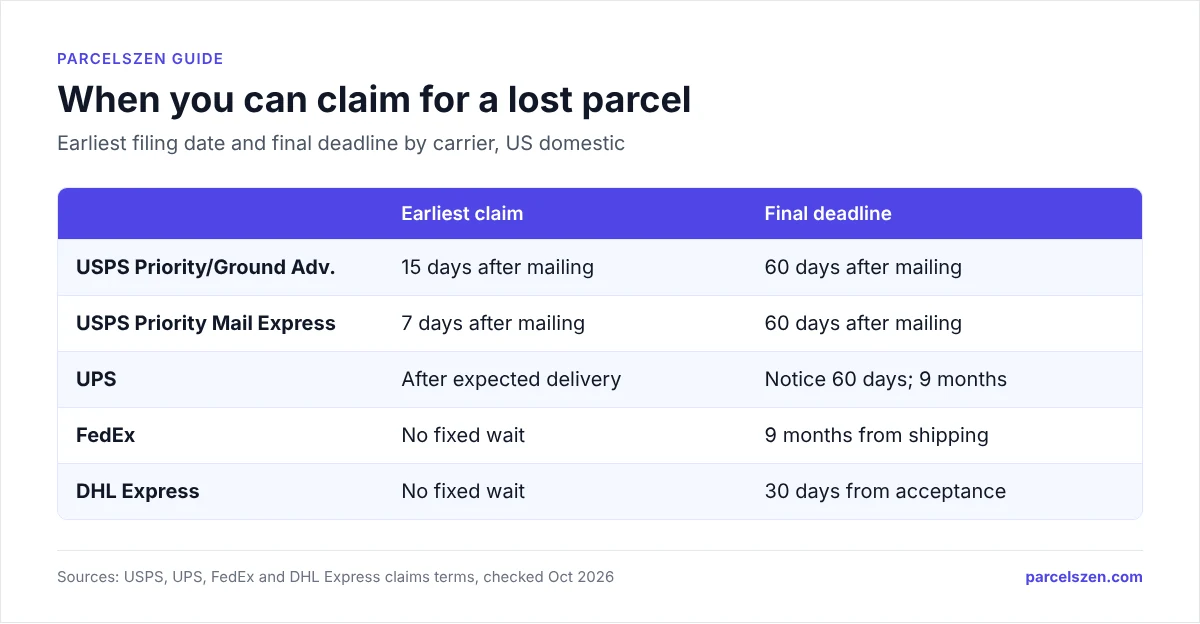
| Service | You must wait | Then file within | Who gets paid |
|---|---|---|---|
| USPS Priority Mail Express | 7 days | 60 days from mailing | Whoever files first and is approved |
| USPS Priority Mail and Ground Advantage | 15 days | 60 days from mailing | Whoever files first and is approved |
| USPS international | 3 days Express International, 7 days Priority Mail International (10 to Canada) | 90 days Express International, 6 months Priority Mail International | Usually the sender |
| UPS | No set wait; UPS counts the 60-day notice window from the scheduled delivery date | Notice within 60 days of delivery or scheduled delivery, then 9 months domestic, 60 days international | The shipper |
| FedEx domestic | No fixed wait | 9 months for loss, 60 days for damage | The shipper |
| FedEx international | No fixed wait | 9 months for loss, 21 days for damage | The shipper |
| DHL Express | No fixed wait | 30 days | The shipper |
📮 USPS ground services
✈️ FedEx international
💷 Who collects
Why this squeezes you
USPS will not accept a Priority Mail loss claim until fifteen days have passed. eBay lets you report an item not received from the estimated delivery date until 30 calendar days after it, and an Amazon A-to-z claim opens three days after the latest estimated delivery date if the seller has not fixed the problem within 48 hours of your message. Amazon accepts the claim only while the order's last possible delivery date is 90 days old or less (all as of October 2026). By the time the carrier is willing to hear from you, half of your eBay window has already run down.
So do not wait for one before starting the other. Open the marketplace case on day three or four, while the carrier waiting period is still running. The two processes are independent, the marketplace does not require a carrier claim to exist, and the case can be withdrawn if the parcel turns up.
The payout goes to the shipper
On UPS, FedEx and DHL the carrier pays the shipper of record, not the person who was waiting for the parcel. You can report a loss and you can push for an investigation, but the cheque goes to whoever bought the label. If you were the buyer, the carrier claim is not your money and never was.
That makes the seller your only realistic route on those three carriers. They hold the contract, they receive the payout, and they can refund you immediately without waiting for the carrier to decide. Asking them to file, rather than filing yourself, is not politeness. It is the only path that ends with you being paid.
Step 5: File an Official Claim
If the carrier search comes back negative and the package is officially determined lost, file a formal claim. Requirements vary by carrier:
- USPS claims: Must be filed 15-60 days after mailing date (domestic). International: after 3 days and before 90 for Express International, after 7 days (10 to Canada) and before 6 months for Priority Mail International
- UPS: File once the scheduled delivery date has passed. Give notice within 60 days of delivery, or of the scheduled delivery date if it never arrived. Deadline: 9 months domestic, 60 days international.
- FedEx: Claims filed at fedex.com
- DHL: Through the DHL claims portal
Claims require: proof of value (receipt, screenshot of purchase), package description, tracking number, and sender/recipient information.
Check the waiting period before you start, because filing early wastes the attempt. A USPS Priority Mail claim submitted on day ten is rejected for being premature rather than held until day fifteen, and you must begin again.
Damage is the exception with no waiting period at all. If the parcel arrived and the contents are broken or missing, you can file immediately, and you should, because photographs of the packaging are evidence that degrades the moment it goes in the bin. The sixty day ceiling still applies.
Documentation decides the outcome more than the story does. USPS asks for proof of value such as a sales receipt or paid invoice, and UPS tells claimants to keep any invoice that shows the value of the package, so the receipt or order confirmation matters more than a detailed account of the wait. Have that ready before you open the form.
Step 6: Use Platform Buyer Protection
If you bought through Amazon, eBay, AliExpress, Etsy, PayPal, or with a credit card, you have additional protection:
- Amazon A-to-z Guarantee: Covers lost packages, contact Amazon directly
- eBay Money Back Guarantee: Covers items not received
- AliExpress buyer protection: Covers orders where tracking shows no delivery
- PayPal: File 'Item Not Received' dispute within 180 days
- Credit card: Dispute the charge with your bank if the seller won't refund
Platform protection is faster than a carrier claim and pays the person who actually lost out. A marketplace decides on the balance of evidence in days, whereas a carrier claim takes weeks and pays the shipper. For a buyer, this route is almost always the better one.
Open it before the carrier claim, not after. The two are independent, and waiting for the carrier to conclude commonly pushes you past the marketplace deadline. Nothing about opening a case early prejudices you, and every platform lets you withdraw one.
Escalate rather than negotiate once a seller stops replying. Marketplaces decide these cases on evidence rather than persistence, and a stalled conversation consumes the window without improving your position. Two unanswered messages is the point to stop writing and start escalating.
Prevention for Next Time
To reduce the risk of lost packages in the future:
- Use tracked shipping whenever possible (not free untracked services)
- Request signature confirmation for valuable items
- Consider a package locker or Amazon Hub for deliveries when you're not home
- Install a doorbell camera
Platform buyer protection windows close. PayPal gives you 180 days from the date you paid to open an Item Not Received dispute, and eBay gives you 30 calendar days after the estimated delivery date (both as of October 2026). For AliExpress, open a dispute from the order page as soon as the parcel is overdue. Don't let these expire before taking action.
Frequently Asked Questions
Quick Reference: Lost Package Action Checklist
Check current tracking status on ParcelsZen first. The right sequence: USPS Missing Mail search before a formal claim, not instead of it. File the carrier claim once its waiting period has passed, and open the marketplace case earlier, three or four days after the estimated delivery date.
- Step 1: Check ALL delivery locations + check with neighbors
- Step 2: Confirm the delivery window has actually passed
- Step 3: Contact seller with the order number, tracking, what tracking shows
- Step 4: USPS Missing Mail search / carrier phone
- Step 5: File formal claim (with proof of value)
- Step 6: Amazon A-to-z / eBay / PayPal (within 180 days) / credit card dispute
Three facts do most of the work here. A parcel is lost when it stops scanning rather than when it is late. The carrier will not hear a loss claim until a waiting period has passed, which on USPS ground services is fifteen days. And on UPS, FedEx and DHL the payout goes to the shipper, so a buyer collects through the seller or not at all.
The practical consequence is to run both processes at once. Report to the seller in the first few days and open the marketplace case while the carrier waiting period is still running. Waiting politely for one before starting the other is how people arrive at day thirty-one with a valid complaint and no route left to make it.
Sources
Official pages this guide relies on, checked in October 2026.
- Domestic Claims - The Basics (USPS)
- Missing Mail and Lost Packages (USPS)
- 2026 UPS Tariff/Terms and Conditions of Service, Section 55: Claims and Legal Actions (UPS)
- File a Claim (FedEx)
- DHL Express Terms and Conditions of Carriage (DHL Express (US))
- eBay Money Back Guarantee policy (eBay)
- A-to-z Guarantee (Amazon Customer Service)