
When tracking freezes for days, the natural reaction is to worry. That's almost always wasted energy. Ground packages cross the country for 4-5 days with zero scans. International packages cross oceans with a 12-36 hour flight blackout. Your package is moving. It is just not getting scanned.
This guide explains the seven most common reasons tracking stops updating, so you can set realistic expectations and know when to be concerned and when not to be.
Enter your tracking number on ParcelsZen to see the latest available status.
How Often Your Service Actually Scans
Three days of silence means opposite things on two different services, and this is the fact that resolves most of these questions. Priority Mail Express is scanned almost hourly, so a three-day gap on it is a genuine problem. Ground Advantage may be scanned three to five times across its entire journey, so a three-day gap on that is simply the middle of the trip.
Every generic guide tells you to wait 24 to 48 hours. That number is meaningless without knowing what you bought.
| Service | Scans across the whole journey | Normal gap | Worry after |
|---|---|---|---|
| USPS Priority Mail Express | Frequent, often several a day | Hours | 24 hours |
| USPS Priority Mail | Moderate | 1 to 2 days | 10 days |
| USPS Ground Advantage | Roughly 3 to 5 in total | 2 to 3 days, up to 5 coast to coast | 15 days |
| UPS Next Day Air | 4 to 6 | Hours | 24 hours |
| UPS Ground | 3 to 4 in total | 1 to 2 days | 7 to 10 days |
| International postal | Very few, and none mid-air | 4 to 10 days | 30 to 45 days |
⚡ Express services
📬 USPS Priority Mail
📦 Ground services
🌍 International postal
Work out which row you are on before anything else. The service is printed on your shipping confirmation, and the tracking number itself often gives it away. A number beginning 9205 is Priority Mail, 9270 is Priority Mail Express, and a 13-character code ending in US is an express or international service.
The count is what matters, not the interval. A service that generates three to five scans in total cannot produce a daily update no matter how well it is running. There is no scan to show you, because there is no facility left to scan it at until it reaches your local one.
Reason 1: The Package Is in Long-Distance Ground Transport
When a package travels across the country by ground, say from California to New York, it may spend 4-5 days in a truck with no intermediate scans. USPS, UPS Ground, and FedEx Ground all have routes where packages travel for multiple days between scanning facilities.
A UPS Ground package going cross-country may show only three or four scans in total over a journey of about 5 days.
Ground networks are built around hubs, and scans only happen at hubs. A parcel crossing the country passes through perhaps three sorting facilities, so it generates roughly three scans in transit however many miles it covers. The distance does not add updates; it adds time between the same small number of them.
This is why a long haul looks worse than a short one on the same service. A parcel travelling two states shows movement every day because the hubs are close together. The identical service crossing eight states shows nothing for two or three days between the same events. Nothing is slower or more at risk. There is simply more road between scanners.
The last leg produces more updates than the whole journey before it. Once a parcel reaches your local delivery facility it is scanned on arrival, sorted, loaded and delivered, so four events can land in a single morning after three quiet days. That burst is the normal shape of a ground shipment, not a sign that something was resolved.
Reason 2: The Package Is in the Air
International packages spend anywhere from a few hours to more than a day in air transport between facilities, and there are no scans during the flight, because the package is in a cargo container inside an aircraft. That is the flight itself, not the whole quiet period: counting the handling at both ends, 4 to 10 days between scans is normal for international postal, which is what the table above gives.
You'll see a scan when it departed (e.g., 'Departed from Shanghai Pudong Airport') and then nothing until it lands and is scanned at the destination facility.
No scan is physically possible while a parcel is in the air. Once it is sealed into a container or unit load device, nothing is scanned until that unit is broken down at the destination. The gap is not a reporting delay. There is genuinely nothing to report.
On a domestic flight this costs you a few hours. On an international postal leg the quiet period is longer, because it covers handling at the export hub and the import hub as well as the flight. The table above puts the normal gap at 4 to 10 days.
The scan that ends this silence is an arrival scan, not a departure one. If your last update reads departed from a facility or in transit to the next facility, you are inside this gap. The next event you see will be at the receiving end, and how long that takes depends entirely on whether the lane is domestic or international.
Reason 3: It's the Weekend or a Holiday
USPS delivers regular mail Monday to Saturday, and on Sundays it delivers Priority Mail Express in many major markets for an extra fee. UPS has no pickups or deliveries on Sunday, and FedEx Home Delivery reaches nearly two-thirds of the US population on Sunday. If your package's last scan was on a Friday and it's now Monday, the 'gap' is just the weekend.
Similarly, all carriers reduce operations around major US holidays (Thanksgiving, Christmas, New Year's, etc.).
Scanning follows the operating schedule, not the calendar. Sorting facilities run reduced shifts at weekends and most carriers do not process ground volume on Sunday at all, so a parcel that arrives at a hub on Friday evening can sit unscanned until Monday morning.
A Friday afternoon dispatch is the most misread situation in tracking. The label is created, the parcel is collected, and then three days pass with nothing. The parcel is exactly where it should be. Add the weekend to any estimate that started on a Thursday or Friday before deciding anything is wrong.
Public holidays compound rather than add. A Monday holiday does not cost one day, it costs the weekend plus the holiday plus the backlog that built during all three, which is why the first update after a long weekend often arrives on Tuesday evening rather than Tuesday morning.
Reason 4: High Volume Periods
During peak periods in November, December, and early January, carriers handle their busiest weeks of the year; USPS said the second week of December 2025 was expected to be the busiest of the year at its Post Office locations. Sorting facilities back up, and packages can sit for an extra day or more between scans.
This is when your 7-day shipping might take 14 days, and tracking may appear frozen.
Peak season does not slow the scanners, it slows everything between them. Facilities still scan at the same points, but parcels queue longer before reaching each one, so the same journey generates the same number of updates spread across more days.
The predictable peaks are worth planning around: the week after Black Friday and Cyber Monday, the fortnight before Christmas, and mid-January when returns flood the network in the opposite direction. Chinese New Year affects anything shipping from Asia for roughly a month either side.
What changes during peak is the threshold, not the behaviour. A gap that would concern you in March is ordinary in December. Add roughly two days to every worry threshold in the table above between late November and the end of December, and do not treat a quiet forty-eight hours in that window as evidence of anything.
Reason 5: The Package Is in International Customs
Packages crossing international borders can sit in customs holding for several days, longer when duty is owed or documents are missing. During this time, tracking typically shows 'In Customs' or 'Clearance in Progress' without any further movement.
Unless you receive a notice requesting documentation or payment, there is usually nothing you can do but wait.
Customs holds produce silence rather than a status. The parcel is physically stationary and no facility is handling it, so no scan is generated. Many carriers do not publish a customs status at all until the parcel is released, which is why the tracking simply stops rather than explaining itself.
Customs time falls inside the international postal gap in the table above. Up to 10 days with no update is ordinary on an international postal parcel, and the worry threshold is 30 to 45 days. Our guide to a package stuck in customs covers which kind of hold you have and who can actually act on it.
One detail that saves a lot of worry: a parcel can clear customs and still show nothing for another day or two, because clearing is a customs event and the next scan is a carrier event. Those are different systems, and the carrier scan only happens once the parcel physically enters its network.
Reason 6: The Carrier Missed a Scan
Not every package gets scanned at every facility. Carriers use automated barcode scanners on conveyor systems, and occasionally a package passes through a facility without being scanned, due to scanner failure, a barcode that won't read, or the package being misrouted.
The next scan will occur when the package reaches a facility that does successfully scan it. The package is still moving. It just was not recorded.
Missed scans are ordinary and self-correcting. A barcode that will not read, a parcel routed by hand, or a scanner that failed to sync all produce the same result: a real event that never reached the tracking page. The parcel moved. The record did not.
You can usually tell a missed scan from a genuine stall by what comes next. If a later update appears at a facility further along the route, the earlier one was simply skipped and nothing is wrong. If the next update repeats the same location, the parcel really is sitting there.
This is more common on services with fewer scan points, because there is less redundancy. On a service that scans three to five times in total, one missed scan removes a fifth to a third of the record, which is why ground shipments look patchier than express ones even when both are running perfectly.
Reason 7: The Package Is Lost or Damaged in Transit
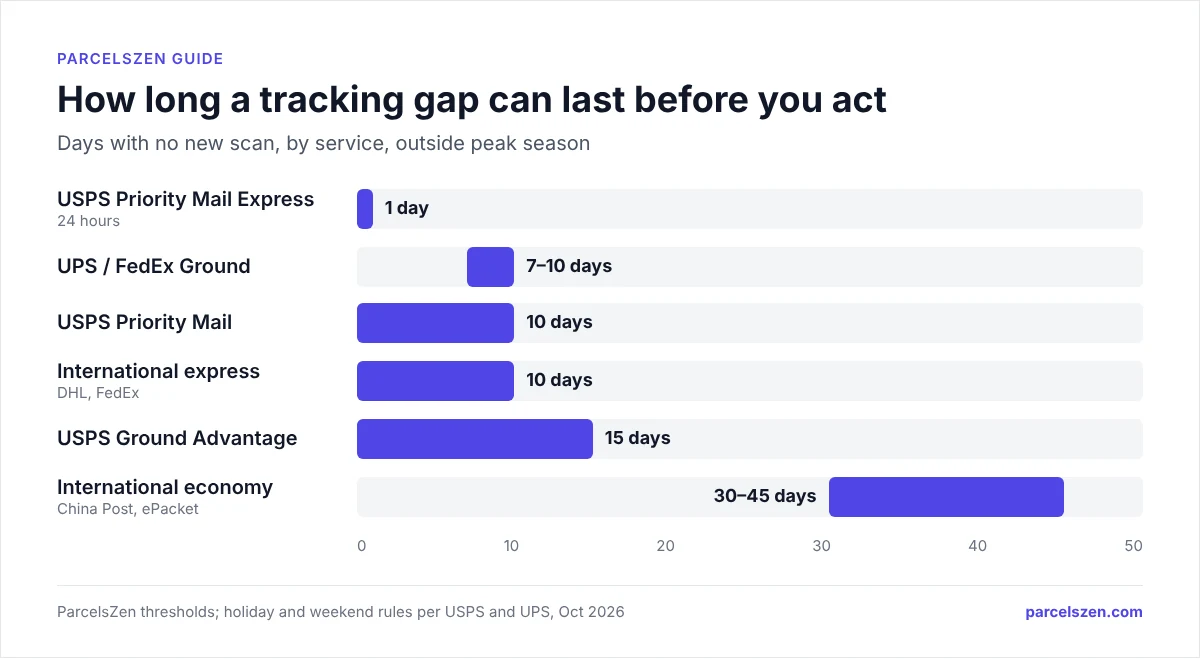
This is the least likely scenario but does happen. If your tracking has genuinely not updated past the worry-after threshold for your service - 10 days on Priority Mail, 15 on Ground Advantage, 7 to 10 on UPS Ground - or 30 to 45 days for international, and it's not a holiday or peak period, the package may have been lost in the network.
See our full guide on what to do if a package is lost for next steps including how to file a carrier claim.
This is the least likely explanation and the last one to reach for. The overwhelming majority of tracking gaps resolve on their own, and every reason above is more common than a lost parcel. Use the thresholds in the table rather than a general sense that it has been too long.
The pattern that actually suggests a problem is a stalled location, not a silence. A parcel that scans into a facility and then scans nothing further for a week is more concerning than one that has shown nothing at all since dispatch, because the first has demonstrably arrived somewhere and stopped.
If you do act, act on the retailer first. They hold the contract with the carrier, can open an investigation you have no standing to open, and can refund or replace without waiting for the outcome. Our guide to a lost package covers the claim windows, which run whether or not you are still waiting.
When Should You Actually Be Worried?
Use the 'Worry after' column in the table at the top of this guide for your service. Those are ParcelsZen's working thresholds, not carrier rules. The official USPS windows to act are:
- Missing Mail search: from 7 days after mailing.
- Lost-package claim: from 15 days after mailing for Priority Mail and Ground Advantage, and from 7 days for Priority Mail Express, up to 60 days.
- UPS and FedEx: start with the sender, who holds the shipping contract; UPS takes claims within 60 days of the scheduled delivery date.
For an international postal parcel (China Post, ePacket), contact the seller once the table's 30 to 45 day threshold passes.
Frequently Asked Questions
Worry Thresholds Quick Reference
Check current status on ParcelsZen before doing anything else. The thresholds in this guide are real: 10 days without a scan on Priority Mail is the point to call. Before that, checking obsessively does not change the outcome, and most of the time the next scan appears on its own.
- USPS Priority Mail: Worry after 10 days
- USPS Ground Advantage: Worry after 15 days
- UPS / FedEx Ground: Worry after 7-10 days
- International economy (China Post, ePacket): Worry after 30-45 days
- International express (DHL, FedEx): Worry after 10 days
- Friday → Monday gap: Weekend only, completely normal
Almost every question about tracking silence has the same answer: check what service you bought. A gap that is alarming on Priority Mail Express is routine on Ground Advantage, and the generic advice to wait 24 to 48 hours applies to neither of them accurately.
The three genuinely quiet stages are worth committing to memory, because between them they explain most gaps: nothing is scanned mid-flight until the cargo unit is opened at the far end, a weekend hub is not processing anything, and customs returns silence rather than a status. None of the three is a fault, and none of them is improved by contacting anyone.
Sources
Official pages this guide relies on, checked in October 2026.
- USPS Tracking® (United States Postal Service)
- Identification of postal items – 13-character identifier (S10-12) (Universal Postal Union)
- Saturday Delivery and Pickup Options | UPS - United States (UPS)
- UPS Holiday Schedule | UPS - United States (UPS)
- 9 Days off in a Row For Upcoming Spring Festival Holiday (Beijing Municipal Government)
- Missing Mail and Lost Packages | USPS (United States Postal Service)