
Two weeks in, tracking says 'In Transit.' Nothing has moved since the package left China. Most people assume something went wrong. Usually nothing has. The package is sitting at an air cargo facility until its consolidated shipment gets space on a flight.
Understanding the complete journey of a package from China to the USA reveals why the process takes longer than domestic shipping, and what you can realistically expect at each stage.
Enter your AliExpress or Chinese carrier tracking number on ParcelsZen for updates, because our system auto-identifies Cainiao, ePacket, Yanwen, 4PX, YunExpress, and China Post.
Step 1: Processing and Packing in the Seller's Warehouse (Days 1-3)
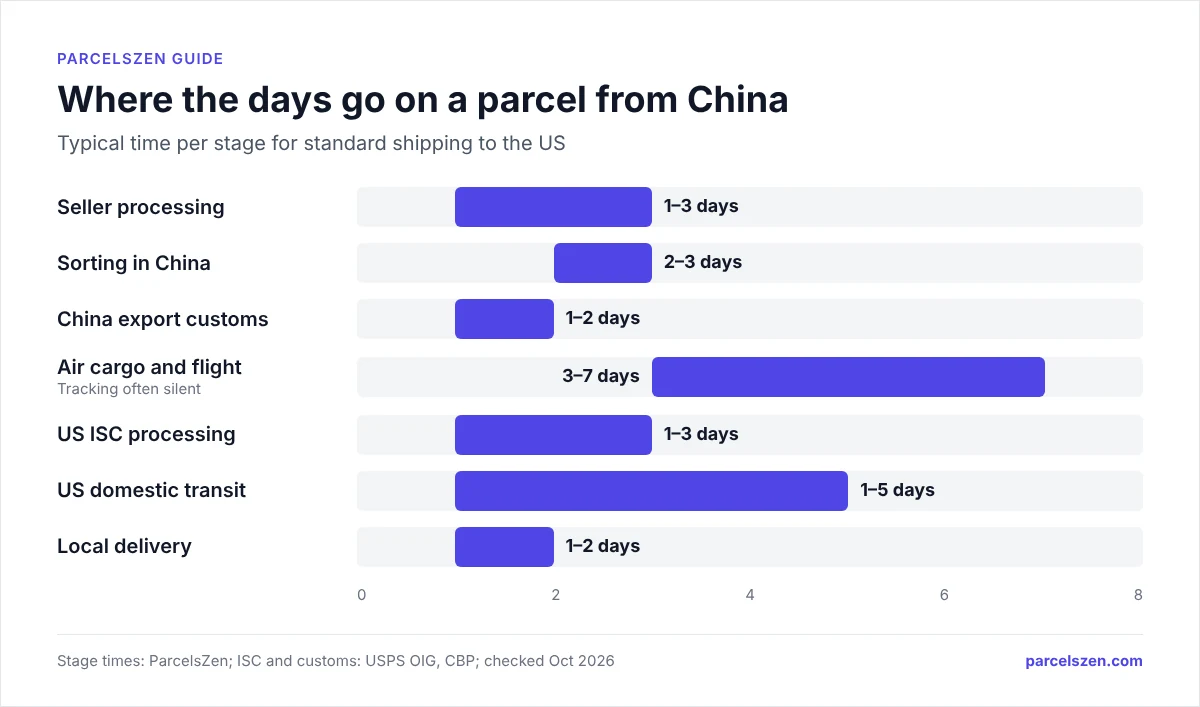
After you place your order, the seller needs to physically pick, pack, and prepare your item for shipping. Many AliExpress sellers operate from small warehouses or even from home, so this takes 1-3 business days.
Some larger sellers on AliExpress and Temu operate through Alibaba's or similar fulfillment centers, which can process orders faster. During this time, your tracking may show 'Order Placed' or 'Processing' but no movement.
This is the stage that produces the most anxious emails and the least tracking. The number you were given at checkout usually exists before the parcel does. It is a pre-generated label, registered with the carrier's system but attached to nothing physical, which is why it returns "information received" or nothing at all for days.
Marketplace listings hide a wide range of sellers. A large Temu or AliExpress seller shipping from a fulfilment centre can hand over the same day. A single-person operation packing at home works through orders in batches, often once every two or three days, and a Sunday order simply waits until the batch runs.
What the silence actually means here: nothing has gone wrong. If the label was created and no scan has appeared after five days, that is when to message the seller, and the useful question is not "where is my parcel" but "has it been handed to the carrier yet".
Step 2: Local Collection and Sorting in China (Days 3-5)
Once packed, the seller hands the package to a local logistics provider (China Post, Cainiao, Yanwen, etc.) for collection. The package is transported to a regional sorting facility in China, often in Guangdong, Zhejiang, or another major e-commerce hub province.
At the sorting facility, packages are consolidated, weighed, and prepared for international transport.
The first real scan is the one that matters, and it is rarely the seller's city. Parcels are collected locally, then trucked to a regional consolidation hub, and the first scan you see is usually the hub rather than the pickup. E-commerce hubs such as Shenzhen, Guangzhou, Yiwu and Hangzhou collect parcels from wide surrounding areas, so a parcel from southern China often appears in Shenzhen or Guangzhou first.
Consolidation is the whole point of the price you paid. Your parcel waits until enough parcels bound for the same destination fill a cargo unit, and that wait keeps economy shipping cheap. Faster services skip the wait by paying for space regardless.
Expect one to three scans total across this entire stage. Chinese domestic legs are scanned far less densely than a US domestic journey, so two updates in four days is normal rather than a sign of a stall.
Step 3: Customs Export in China (Days 4-6)
All packages leaving China must clear Chinese export customs. For consumer goods from major e-commerce platforms, this is typically automated and fast (24-48 hours).
However, during certain periods such as Chinese Golden Week holidays or Lunar New Year, or when new regulations apply, export processing can be slower.
Track Your Package from China
Enter your AliExpress or Chinese carrier tracking number for status updates.
Track Your PackageExport customs on a consumer parcel is a paperwork check, not an inspection. Customs is confirming that the manifest matches the declared contents and that nothing on it is restricted for export. Individual parcels are rarely opened at this stage, which is why it usually passes in a day or two.
The delay here is almost always volume, not scrutiny. After Singles Day on 11 November, Black Friday and Chinese New Year, export facilities process a backlog rather than a queue, and a stage that normally takes two days can take six.
Chinese New Year is the one to plan around. Factories, sellers and couriers shut for roughly two weeks, and the backlog before and after it stretches the whole chain. A parcel ordered a week before the holiday can sit untouched until operations resume.
Step 4: Air Transport from China to USA (Days 6-10)
Most packages travel from China to the USA by air cargo. The flight itself from Shanghai or Hong Kong to the US West Coast takes about 11 hours.
However, air cargo doesn't mean your package is on the next available flight. Packages are consolidated, loaded in cargo pallets, and shipped when space is available. This can mean a wait of 2-5 days at the Chinese air cargo facility.
The flight is the shortest part of the journey and the longest silence. Shanghai or Hong Kong to the US West Coast is about eleven hours in the air. The parcel is typically in this stage for three to seven days, and almost all of that is waiting for space on a departure rather than flying.
This is where tracking goes fully dark. Once a parcel is loaded into a cargo unit, no scan happens until the unit is broken down at the destination. Four to six days with no update at all is the normal shape of this stage. It is the single most misread silence in the entire journey.
Cargo space is sold by weight and volume, and consumer parcels are the lowest priority. When capacity tightens, which happens every peak season, commercial freight is loaded first and small packets roll to the next available flight. That is why the same route runs slower in November and December than in March.
Step 5: US Port of Entry Processing (Days 10-13)
When the cargo plane lands in Los Angeles, San Francisco, Anchorage, or another US entry point, the cargo is off-loaded and screened. For packages arriving via postal channels (China Post to USPS), they go to a USPS International Service Center (ISC) for processing.
This takes 1-3 days under normal conditions.
Two different things happen here and they are often confused. CBP screens the inbound consignment, and the destination carrier inducts your individual parcel into its own network. The first is a customs step, the second is a logistics step, and a parcel can clear customs quickly and still sit waiting for induction.
Postal-channel parcels go to an International Service Center. There are four, at New York, Miami, Chicago and Los Angeles, and you are routed by arrival airport rather than by your address. A parcel bound for Florida can appear in Chicago, and the city in that scan tells you nothing about where it goes next.
The US ended duty-free treatment of shipments valued at $800 or less for China and Hong Kong on 2 May 2025 and for all countries on 29 August 2025 (Executive Order 14324). On 24 June 2026 CBP published two interim final rules that suspend the exemption indefinitely: one for mail (Federal Register 2026-12669) and one for all other modes (2026-12670). The statutory exemption is repealed from 1 July 2027. Low-value purchases now owe all applicable duties; bona fide gifts valued at $100 or less stay duty-free. Purchases from China now go through a formal or informal customs entry at this stage, so allow extra time if the carrier asks you for payment or details.
Step 6: US Domestic Transit (Days 13-16)
After clearing the ISC, your package enters the USPS domestic network and is routed to your local sorting facility. Depending on where you are in the country, this adds 1-5 days. A package arriving in Los Angeles that is destined for New York will travel cross-country.
From here your parcel behaves exactly like a domestic one. The tracking number does not change, USPS or the final carrier scans it into their network, and the delivery timing follows their normal schedule rather than anything to do with China.
The number of scans jumps sharply at this point, which is why the last few days in the USPS network usually produce more tracking updates than the whole journey before them. Nothing has sped up. The network you are now in simply scans more often.
If something goes wrong after the first US scan, the US carrier is who to contact. The Chinese seller and the origin carrier can no longer see the parcel or act on it, and asking them wastes days. Anything after that scan is a domestic problem with a domestic solution.
Step 7: Local Delivery (Days 15-20 for ePacket, Longer for Standard)
Finally, your local mail carrier delivers the package:
- ePacket from China: typically 7-20 days under normal conditions
- Standard China Post registered mail: 15-35 days
- Express (DHL/FedEx from China): 1-3 business days in transit for FedEx International Priority (as of October 2026), plus pickup and US customs time
A combination of slow export processing in China, delays in air cargo consolidation, US customs inspection, and busy domestic USPS periods can stack up. This is more common during November-January and during any global supply chain disruptions.
Frequently Asked Questions
Track Your Package from China on ParcelsZen
Enter your AliExpress tracking number into ParcelsZen for updates from China to your door. The gap between 'Departed [Chinese city] Airport' and 'Arrived at ISC' usually runs 3-7 days and runs longer in peak season. If there's no movement 15 days after 'Departed', contact the seller. That's the threshold where acting actually helps.
- Days 1-3: Seller processing, showing 'Order Placed' or 'Processing'
- Days 3-6: China sorting and export customs
- Days 6-10: Air cargo (tracking gap normal here)
- Days 10-13: US ISC processing, showing 'Arrived at ISC'
- Days 13-20: US domestic transit and local delivery
Two silences explain almost every "why is it taking so long" question. The first is before the parcel physically exists, when the label is created and nothing has been collected. The second is the air-cargo leg, when the parcel is sealed inside a unit and no scan is possible until it is broken down. Neither is a problem, and together they account for most of the wait.
If you have been reading about container consolidation, terminal cutoffs and port congestion, that guidance is not about your parcel. Those articles describe commercial freight moving by sea in containers. A phone case from AliExpress travels by air in a mixed cargo unit and never sees a container terminal at all.
Sources
Official pages this guide relies on, checked in October 2026.
- Postal Service Initiates ePacket Service with Hongkong Post (USPS Newsroom)
- U.S. Postal Service International Mail Operations and Performance Data (Report 21-197-R22) (USPS Office of Inspector General)
- Notice of Implementation of Additional Duties on Products of the People's Republic of China Pursuant to Executive Order 14256 ... As Applied to Low-Value Imports (Federal Register (govinfo.gov))
- Suspending Duty-Free De Minimis Treatment for All Countries (Executive Order 14324) (The White House)
- Indefinite Suspension of the De Minimis Exemption for Mail Shipments and New Postal Informal Entry Process (Federal Register (U.S. Customs and Border Protection))
- Notice for Upcoming Holiday: 3 Consecutive Days off! (Beijing Municipal Government)