
Every international package must clear US Customs and Border Protection (CBP). For most consumer parcels CBP's review is automated and needs no forms or action from you. Since 29 August 2025 every parcel is assessed for duty whatever its value, so many more parcels now carry a duty charge, and a smaller number are held for documents or examination (status as of October 2026).
This guide explains exactly what happens to your package at US customs, how long it typically takes, and what you can do if it gets stuck.
Track your international package's customs status on ParcelsZen. It shows the scans USPS publishes for an inbound parcel, including ISC arrival and any customs event.
How US Customs Works
Every parcel entering the United States is presented to Customs and Border Protection before it can be delivered. That has always been true. What changed in 2025 is what happens next.
The process runs in three stages. Manifest: the carrier transmits electronic data about the shipment, its contents, declared value and recipient, before the aircraft lands. Assessment: CBP decides whether the parcel clears automatically, needs duty calculated, or warrants examination. Release: cleared parcels are handed to the domestic carrier for delivery.
The vast majority of this is automated. CBP's targeting systems evaluate the electronic manifest against risk rules, and parcels that raise nothing are released without a human ever seeing them. This is why many parcels clear without a visible delay, and why your tracking may never show a customs step at all.
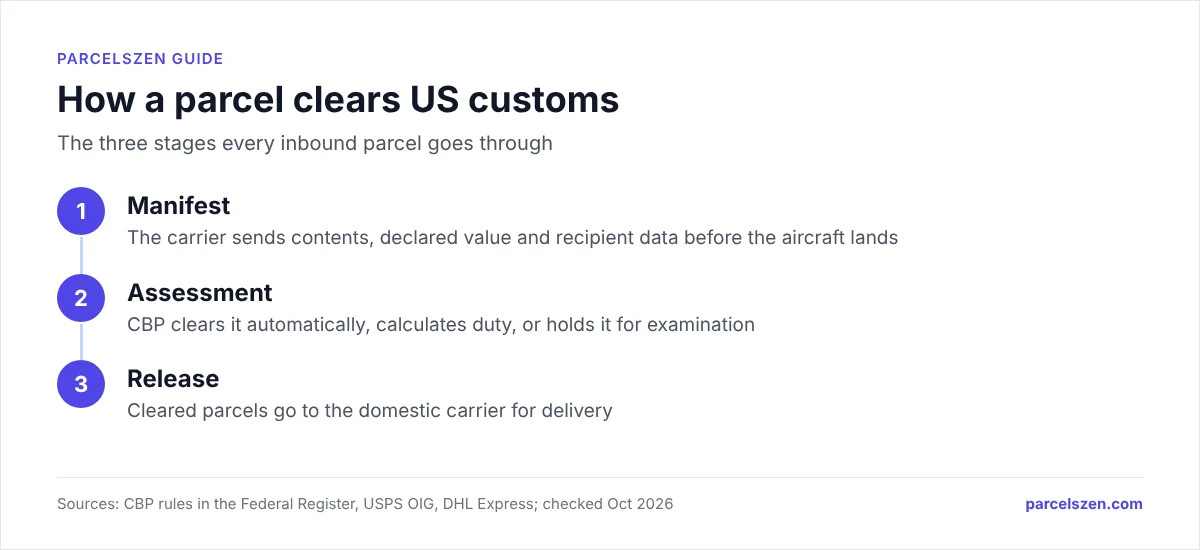
The step that changed is assessment. Until 2025 most consumer parcels were waved through under a duty-free allowance, so assessment was a formality. Now that allowance is suspended, duty assessment applies to inbound parcels generally rather than to a minority, which adds a processing step to shipments that previously skipped it.
The De Minimis Allowance and Why It No Longer Applies
For years, parcels valued under $800 entered the United States duty-free. That is no longer the case. If you have read elsewhere that orders under $800 arrive without duty, that guidance is out of date and following it will produce unexpected bills.
Section 321 of the Tariff Act allowed shipments below a set value to enter free of duty with minimal formality. That threshold was raised to $800 on 10 March 2016, up from $200, under the Trade Facilitation and Trade Enforcement Act of 2015, and it is the rule most online shopping advice still describes. It was withdrawn in stages.
| Date | What changed | Effect on consumers |
|---|---|---|
| 2 May 2025 | Allowance ended for China and Hong Kong | Marketplace orders from Chinese sellers became assessable |
| 29 August 2025 | Removal extended to all countries | Origin no longer exempts a parcel |
| 24 June 2026 | CBP published two interim final rules suspending the exemption indefinitely, one for mail (FR 2026-12669) and one for all other modes (FR 2026-12670); the statutory exemption is repealed from 1 July 2027 | No duty-free entry by value for consumer parcels |
📅 May 2025
📅 August 2025
📅 June 2026
What this means in practice. A parcel that would have entered duty-free before 2 May 2025 (from China or Hong Kong) or before 29 August 2025 (from anywhere else) now goes through duty assessment. The amount depends on what the item is and where it was made, not on whether it fell under a threshold. Small orders are no longer automatically exempt, and the assumption that a cheap parcel is a duty-free parcel no longer holds.
The practical consequence for most shoppers is a bill from the carrier rather than from CBP. For courier parcels (DHL, FedEx, UPS), the carrier usually pays the duty to CBP and bills you before or at delivery, often with a handling fee added. For mail parcels, the owner or purchaser of the goods, or a customs broker they appoint, files the entry and pays CBP, and USPS does not collect duty at your door. If a courier parcel is being held pending payment, that is normally what has happened.
The International Service Centers (ISCs)
Postal parcels entering the United States pass through an International Service Center, a joint USPS and CBP facility where inbound international mail is presented for customs processing.
There are four: New York (JFK), Miami, Chicago and Los Angeles. Your parcel is routed to whichever one serves its arrival airport, not the one nearest your address, which is why a package to Florida can appear in Chicago.
At the ISC the parcel is scanned into the USPS network, presented to CBP, and either released for onward domestic transport or held for assessment or examination. The tracking events you see are typically Arrived at USPS Regional Origin Facility, sometimes Customs Clearance, then Processed Through Facility.
ISCs are also the most common place for a parcel to appear stalled. High inbound volume, a customs queue and the handoff into domestic mail all happen in the same building, so several days at an ISC is normal rather than a sign of a problem. Courier shipments with FedEx, UPS or DHL do not use ISCs at all: those carriers clear parcels through their own facilities under their own broker arrangements, which is part of why express services move faster through the border.
What Triggers a Customs Hold?
Most parcels are never held. The ones that are usually fall into one of these categories.
- Incomplete or vague declarations. A customs form reading "gift" or "sample" with no description gives CBP nothing to classify. Specific descriptions clear faster than vague ones.
- Undervaluation. A declared value that does not match the contents invites scrutiny. Sellers who under-declare to help buyers avoid duty frequently cause the delay instead.
- Restricted or regulated goods. Food, plant material, cosmetics, supplements, medicines, electronics with lithium batteries and anything requiring another agency's approval can be referred for review.
- Suspected counterfeits. Branded goods from marketplaces are a standing enforcement priority, and a parcel suspected of carrying counterfeit trademarks can be detained or seized.
- Random selection. CBP examines a proportion of shipments regardless of content. Nothing about your parcel needs to be wrong.
- Duty assessment. Every parcel is now assessed for duty. A courier parcel can wait until you pay the duty the carrier advanced, which is a payment step rather than a customs hold.
Only the first two are within anyone's control, and both sit with the sender rather than you. If you are buying something unusual, asking the seller to describe the contents accurately on the customs form is the single most useful thing you can do.
How Long Does Customs Hold a Package?
| Situation | Typical additional time | Action needed from you |
|---|---|---|
| Automatic clearance | Hours to 3 days | None |
| Duty assessment | Until the duty is paid | Pay the carrier's invoice |
| Physical examination | No set time | None, wait |
| Documentation request | Until you respond | Supply what is asked, promptly |
| Formal entry required | Until the entry is filed | May need a broker |
✅ No action needed
💳 Payment needed
📄 You must respond
The category that genuinely stalls is the documentation request, because the clock stops until you act. Notices are sent to the address or contact details on the shipment, which may be the seller rather than you, so an unanswered request can sit for weeks without either party realising.
Duties and Taxes: What You Might Owe
With the value-based exemption suspended, the question is no longer whether duty applies but how much. Three things decide it.
- What the item is. Duty rates are set by tariff classification, and they vary widely. A cotton T-shirt (HTS 6109.10.00) has a 16.5% general rate, while a digital still camera (HTS 8525.89.40) has a 0% general rate, before any extra duty on goods from China (rates as of October 2026).
- Where it was made. Country of origin is where the goods were manufactured, not where they were posted. Additional origin-specific measures can apply on top of the base rate.
- How it entered. Postal and courier shipments are processed differently, and the rate applied to a postal parcel is not always the rate a commercial import of the same goods would attract.
There is no federal sales tax on imports, so unlike the UK or the EU there is no VAT layer added at the border. What you are billed is duty plus whatever the carrier charges to handle the entry.
The carrier's fee is separate and often overlooked. Couriers charge a brokerage or disbursement fee for advancing the duty and filing the entry, and on a small parcel that fee can exceed the duty itself. It is a commercial charge, not a government one, which is why it varies between carriers.
If you want to estimate a landed cost before ordering rather than discover it at the door, our import duties and taxes guide works through how the calculation is built for a range of destinations.
What to Do If Your Package Is Stuck in Customs
If your tracking shows 'Arrived at ISC' or a customs-related status for more than 7 days, here's what to do:
- Check for notifications from CBP or your carrier requesting documentation. If you owe duties, the package won't move until you pay.
- Contact the carrier: USPS at 1-800-275-8777, FedEx, DHL, or UPS at their respective numbers, with your tracking number and ask for a status update.
- For packages stuck at the ISC for 10+ days, you or the sender can open a case with USPS customer service; if the parcel is lost, ask the sender to file an inquiry with the postal service of the country it was mailed from, because USPS pays inbound claims to the sender.
Frequently Asked Questions
Track Your Package Through US Customs on ParcelsZen
Track your customs status on ParcelsZen to see the USPS scans from ISC arrival to delivery. Most packages clear without any action from you. If a parcel has sat at the ISC for more than 7 days, check for a duty or document request, then call the carrier.
- Arrived at ISC: In US customs
- Processing Complete: Customs cleared, domestic delivery begins
- Stuck 7+ days? Check for duty notifications, contact carrier
- Stuck 10+ days? Contact USPS; the sender files any loss inquiry
- Duty now applies broadly: value alone no longer exempts a parcel
Most parcels still clear without a hold. What changed in 2025 is that every parcel is assessed for duty, which adds a processing step and, on courier parcels, often a bill before delivery.
What is different since 2025 is that a low declared value no longer buys an exemption. Duty is decided by what the item is and where it was made, so a $40 parcel and a $400 parcel are both assessable, and the bill usually arrives from the carrier with a brokerage fee attached rather than from CBP directly. Budget for that before you order rather than at the door.
Sources
Official pages this guide relies on, checked in October 2026.
- Administrative Exemption on Value Increased for Certain Articles (CBP Dec. 16-13), Customs Bulletin Vol. 50 No. 37 (U.S. Customs and Border Protection)
- Notice of Implementation of Additional Duties on Products of the People's Republic of China Pursuant to Executive Order 14256 ... As Applied to Low-Value Imports (Federal Register (govinfo.gov))
- Suspending Duty-Free De Minimis Treatment for All Countries (Executive Order 14324) (The White House)
- Indefinite Suspension of the De Minimis Exemption for Merchandise Arriving Through All Modes Other Than the International Postal Network (Federal Register (U.S. Customs and Border Protection))
- Indefinite Suspension of the De Minimis Exemption for Mail Shipments and New Postal Informal Entry Process (Federal Register (U.S. Customs and Border Protection))
- U.S. Postal Service International Mail Operations and Performance Data (Report 21-197-R22) (USPS Office of Inspector General)
- FAQs – Duties and Taxes (DHL Express (US))