
Porch pirates grab what's visible and easy. A package at a side entrance, behind a planter, or inside an Amazon Locker doesn't get stolen. That's the whole strategy.
Understanding When Theft Happens
The typical porch pirate opportunistically grabs packages that are visible and easily accessible. Most thefts occur:
- When packages are visible from the street
The best defense is making your packages invisible from the street or unavailable for quick grab-and-run.
Porch theft happens at the front door, which tells you where prevention actually has to work. This is not organised crime moving down a street with a van. It is opportunistic, brief, and defeated by making the parcel invisible from the pavement.
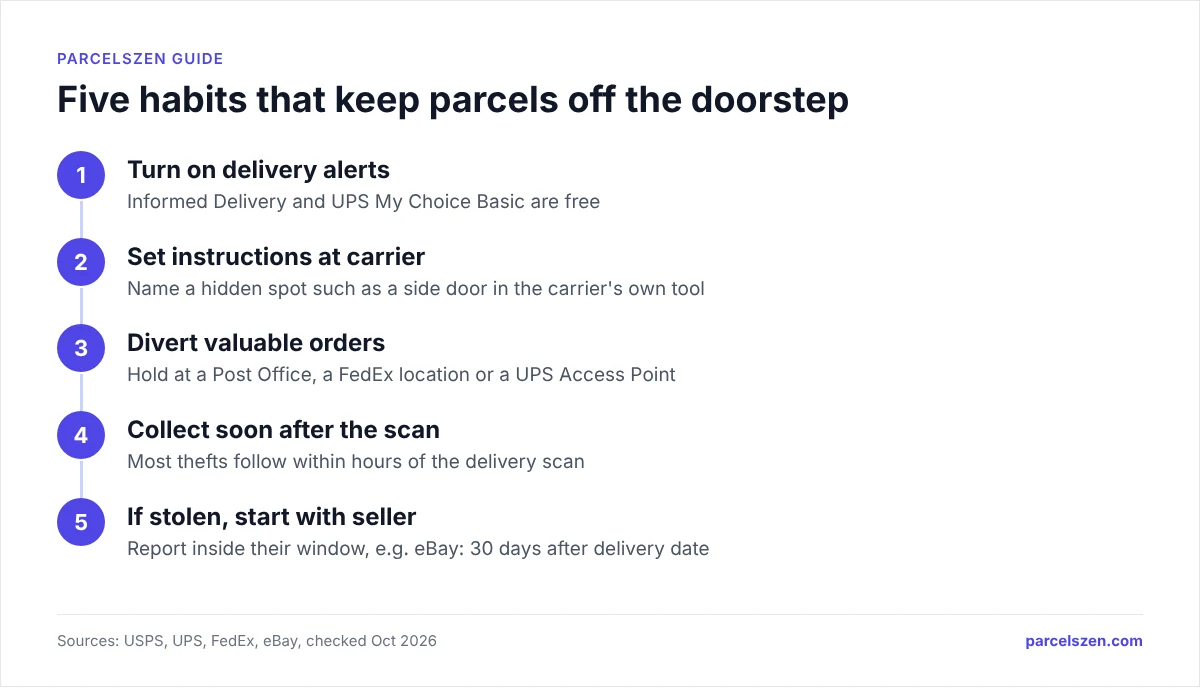
The exposure window is short and predictable. Most residential deliveries land between mid-morning and early evening, and most thefts follow within the first few hours, while the household is out. A parcel collected within an hour of the delivery scan is at very low risk, which makes notifications more valuable than any physical measure.
The holiday peak raises the risk. Volume peaks between Black Friday and Christmas, and so does theft, because more parcels sit unattended for longer. If you only change one habit for one month of the year, make it that month.
Strategy 1: Delivery Instructions
All major carriers allow you to leave delivery instructions. Use these to direct carriers to less visible locations:
- 'Leave behind the large planter on the left of the door'
- 'Leave at the side gate'
- 'Place in the garage if door is open'
UPS My Choice, FedEx Delivery Manager, and USPS Delivery Instructions (also reachable from the Informed Delivery dashboard) all allow detailed instructions. Amazon's delivery preference system also allows specific placement instructions.
Delivery instructions work because they remove the decision from the driver. Without one, a driver picks the spot that looks safest to them in ten seconds, which is usually the most visible flat surface by the door. With one, the parcel goes where you chose.
Be specific and physical rather than polite. "Please hide" achieves nothing. "Behind the green bin, left of the gate" is a location a stranger can find in five seconds and a passer-by cannot see. The best instructions name an object and a direction.
Set them at the carrier, not only at the retailer. A note in an order form frequently never reaches the driver, because the retailer prints a label and the carrier routes it. Instructions saved in UPS My Choice, FedEx Delivery Manager or USPS Delivery Instructions reach the handheld device the driver actually reads.
Strategy 2: Package Lockers and Secure Boxes
- Amazon Hub Lockers: Available in thousands of locations (grocery stores, convenience stores, Amazon warehouses). Direct your delivery to a nearby locker and pick it up using a code. Completely eliminates porch piracy risk for Amazon orders.
- UPS Access Points: UPS partners with local businesses to serve as secure package pickup points.
- FedEx OnSite: FedEx's version at Walgreens, grocery stores, and other locations.
- Smart Package Boxes: A locking parcel box gives the driver a place to leave parcels out of sight. Prices vary by size and lock type; before you buy, check that the carriers you use will leave parcels in it.
Track Your Delivery
Know when your package is expected to arrive so you can be ready to retrieve it.
Track Your PackageThe economics decide this, not the security. A lockable box pays for itself against a single stolen laptop or never, depending on what you order. Work out what you actually receive before buying hardware.
Free alternatives cover most cases. Amazon Locker, UPS Access Point and FedEx OnSite hold parcels at a staffed or secured location at no cost, and Hold for Pickup at a Post Office does the same. For anything valuable, redirecting to one of these is more effective than any box on a porch and costs nothing.
Strategy 3: Smart Doorbells and Cameras
Doorbell cameras record evidence for a claim; they rarely stop a theft in progress:
- Ring Video Doorbell: Sends instant alerts when someone is at your door. Cloud storage with subscription. Can speak to the delivery person in real time.
- Google Nest Doorbell: Similar features, integrates with Google Home.
- Simplisafe, ADT: Full security systems with outdoor cameras.
Cameras rarely prevent a theft and frequently win the claim. A thief taking eight seconds is gone before any alert reaches you, so treat the camera as evidence collection rather than deterrence. That is still worth having, because footage converts a dispute about whether the parcel arrived into a documented theft.
Export the clip the same day. Consumer systems delete on a rolling cycle, commonly thirty to sixty days depending on the plan, and some retain nothing without a subscription. By the time a claim reaches the stage where footage matters, the footage is often gone.
Position for faces and plates, not for parcels. A camera aimed at the doorstep captures the top of a hood. One covering the approach path captures a face, and one covering the kerb captures a vehicle. Police act on identifiable people and registration numbers, and on very little else.
Strategy 4: Delivery Management Apps
- USPS Informed Delivery: A free service where USPS emails you every morning showing the mail and packages scheduled for delivery that day. You can see what's coming and be home or ask a neighbor.
- Amazon Delivery Notifications: Push notifications when your Amazon package is delivered.
- UPS My Choice and FedEx Delivery Manager: Notifications, delivery management, and real-time tracking.
USPS Informed Delivery costs nothing and takes 2 minutes to set up at informeddelivery.usps.com. You'll know about every package before it arrives, so you can plan to receive high-value deliveries.
The notification is the actual security measure. Since most thefts happen in the first hours after delivery, an alert that lets you or a neighbour collect the parcel quickly removes the window entirely. This is free and beats every physical measure on cost.
Set up the carrier apps before you need them. UPS My Choice and FedEx Delivery Manager both verify your address by post or code, which takes a day or two, and neither will help with a parcel already in transit. USPS Informed Delivery previews mail and lets you reschedule, though it cannot change a delivery address.
Rescheduling is underused and the strongest option available. Both UPS and FedEx let you push a delivery to a day you are home, or divert it to an access point, before the first attempt. A parcel that arrives when someone is there cannot be taken from the step at all.
Strategy 5: Community Approaches
- Ask a trusted neighbor to grab packages when you're away
- In neighborhoods with a Ring camera network, thieves caught on camera are often identified through the Ring Neighbors app
A neighbour is the cheapest and most effective measure on this page. Someone at home during the day, a reciprocal arrangement, and a delivery instruction naming their house solves the problem completely for no money and no hardware.
Neighbourhood apps are for recovery, not prevention. Posting on Nextdoor or a Ring group after a suspected theft sometimes recovers a parcel, because it may have been delivered to the wrong house and a neighbor may be holding it. As prevention they do very little.
Ask before assuming. Drivers frequently leave parcels with whoever answers a door, and a neighbour who accepted one on Friday may not think to mention it until Monday. Checking with the three nearest houses resolves a meaningful share of suspected thefts before any claim is needed.
Which Route Actually Gets Your Money Back
Four routes are always listed and three of them fail on the arithmetic. Working out which one applies to you takes about ten seconds and saves the fortnight most people spend on the others.
| Route | When it works | Why it usually does not |
|---|---|---|
| The retailer or marketplace | Almost always | Only if you miss their reporting window |
| Carrier insurance | Rarely, once scanned delivered | Cover ends at the delivery scan. A parcel scanned delivered then stolen is excluded |
| Home or renters insurance | Above your deductible | Your deductible may exceed the parcel's value. |
| Card purchase protection | Sometimes, within the card issuer's time limit | Secondary cover. It sits behind the insurance you just ruled out, and needs a police report |
✅ Start here
❌ Rules itself out
⚠️ Last resort
The arithmetic most guides skip
Compare the parcel's value with your own policy's deductible before you claim: if the item is worth less than the deductible, the insurer pays nothing. In that case a claim is not merely inconvenient, it is impossible to profit from: you would pay the deductible, receive nothing, and carry a claim on your record that can raise your premium for years.
Card purchase protection is described as a backstop and behaves like one. Most issuers make it secondary, meaning you are expected to claim on your home policy first. Since that policy is usually the wrong tool for a hundred dollar item, the card route stalls at the same arithmetic. It becomes genuinely useful above the deductible, which is also where home insurance starts working.
Carrier insurance is the route people try first, and the hardest to use after a Delivered scan. Cover runs while the parcel is in the carrier's hands. Once it is scanned as delivered the carrier's obligation is discharged, and theft from your step afterwards usually falls outside standard carrier cover.
Why the retailer is the answer
Who carries the legal risk depends on the sale terms and state law, so start with the retailer's own policy: eBay's Money Back Guarantee, for example, covers items not received if you ask within 30 calendar days after the estimated or actual delivery date. A marketplace will usually refund a documented non-receipt without argument even when tracking shows delivered.
Report inside their window, which is commonly thirty to ninety days. That is the only failure mode on this route, and it is entirely avoidable. Report on the day you discover the theft rather than after you have spent a week trying the other three.
What to Do If Your Package Is Stolen
- Report to police: File a report at your local police department, because many carriers and insurance companies require this for claims
- Contact the carrier: Report the theft and ask whether its claim process covers a parcel already scanned as delivered
- Contact the seller/platform: Amazon, eBay, and most major retailers will reship or refund for stolen deliveries
- Review camera footage: If you have a doorbell camera, the footage may help police identify the thief
Frequently Asked Questions
Quick Summary: Package Theft Prevention Checklist
Track deliveries on ParcelsZen to know your estimated arrival window. The most underrated prevention tool: USPS Informed Delivery, completely free. You'll see the status of incoming USPS packages before they arrive, so you can be home, or ask a neighbor to grab anything valuable.
- Delivery instructions: UPS My Choice / FedEx Delivery Manager / Amazon preferences, directing to hidden spots
- Amazon Hub Locker: Free pickup at nearby locations, with zero porch piracy risk
- UPS Access Points / FedEx OnSite: Secure pickup at local businesses
- Smart package boxes: BoxLock, Porch Pod, $50-$200
- Ring / Nest doorbell: Records evidence for a claim
- USPS Informed Delivery: Free daily email showing incoming packages
- Community: A neighbor who can take in parcels; Nextdoor or Ring Neighbors after a theft
- If stolen: Police report → carrier claim → seller/platform reship or refund
Sources
Official pages this guide relies on, checked in October 2026.
- Informed Delivery - Mail & Package Notifications | USPS (United States Postal Service)
- USPS Delivery Instructions™ - The Basics (United States Postal Service)
- View and Track All Shipments With UPS My Choice® | UPS - United States (UPS)
- Hold at Location | FedEx (FedEx)
- Adjusting your video storage time (Ring (Amazon))
- eBay Money Back Guarantee policy (eBay)