
A $30 sweater ordered from a US site can arrive with nothing to pay, or with a bill for tax plus a handling fee that costs more than the tax did. The difference is not the seller, the price or the product. It is how the parcel travelled and which country it was shipped from, and almost nobody checks either before ordering.
Canada runs three different duty-free thresholds at the same time, and the gap between the lowest and the highest is more than sevenfold. This guide covers all three, the provincial tax that applies once you cross them, and the handling fees that appear on top.
Track any package heading to Canada on ParcelsZen, across Canada Post, USPS, UPS, FedEx and 1,000+ carriers through our tracking data providers, with no account needed.
Canada's three de-minimis thresholds
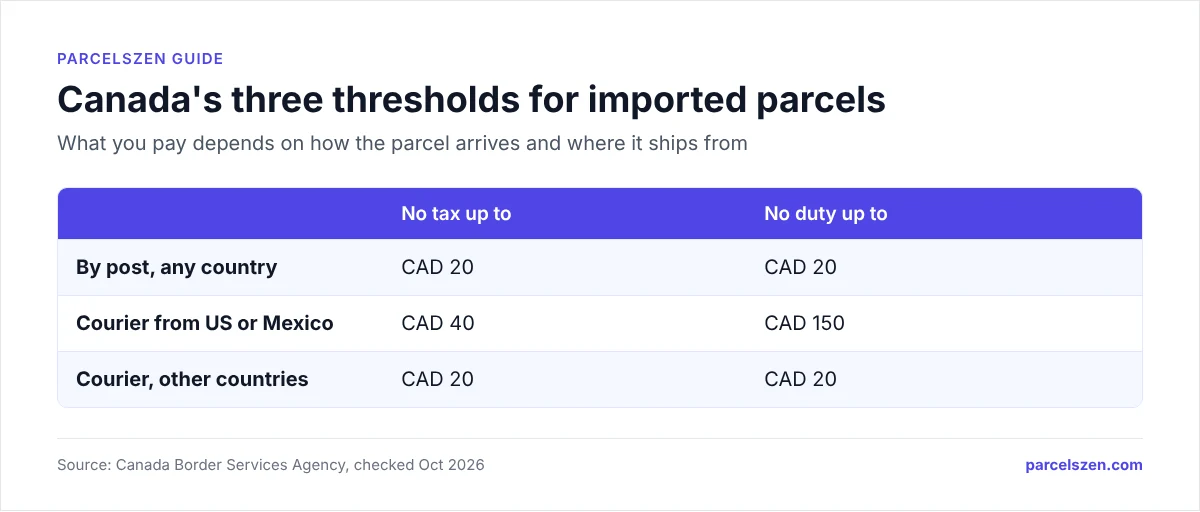
The Canada Border Services Agency applies a different threshold depending on whether your parcel arrives as mail or by courier, and on the country it was shipped from rather than the country it was made in. Check the 'ships from' location on the product page before you order.
| How it arrives | Shipped from | Duty-free up to | Tax-free up to |
|---|---|---|---|
| Mail (Canada Post) | Any country | CAD 20 | CAD 20 |
| Courier (UPS, FedEx, DHL) | United States or Mexico | CAD 150 | CAD 40 |
| Courier (UPS, FedEx, DHL) | Any other country | CAD 20 | CAD 20 |
📬 Mail, any country
🚚 Courier from US or Mexico
🚚 Courier from elsewhere
The higher courier thresholds come from CUSMA, the trade agreement that replaced NAFTA in July 2020. Between CAD 40 and CAD 150 a courier shipment from the US or Mexico pays tax but no duty. Above CAD 150 both apply.
CBSA applies the higher thresholds based on the place of direct shipment. Goods do not have to be made in the US or Mexico to qualify, but they must have entered the commerce of one of those countries before travelling to Canada. A Chinese-made item bought from a US retailer and shipped from a US warehouse qualifies. The same item drop-shipped directly from China does not, even though the website was American.
Why the same order costs different amounts
Take a CAD 100 order from a US retailer. Nothing about the item changes, only the shipping method:
- By courier from a US warehouse: above the CAD 40 tax threshold, so sales tax applies, but below CAD 150, so no duty. Plus the courier's brokerage fee.
- By post from the same warehouse: above CAD 20, so both duty and tax apply. Plus the CAD 9.95 Canada Post handling fee.
- By courier, drop-shipped from China: the CUSMA thresholds do not apply, so it falls back to CAD 20 and both duty and tax apply.
That is the same purchase, from the same website, arriving three ways with three different bills. When a retailer offers a choice at checkout, the courier option from a US location is usually cheaper overall on orders between CAD 40 and CAD 150, even when the shipping line costs more, because it removes the duty entirely.
GST, HST and PST: what you pay by province
Once a parcel crosses the tax threshold, CBSA collects tax at the rate of your province of residence, not the rate where the parcel entered the country. The federal GST is 5% everywhere. What sits on top of it varies enormously.
| Province or territory | Tax type | Total rate on imports |
|---|---|---|
| Alberta | GST only | 5% |
| Northwest Territories | GST only | 5% |
| Nunavut | GST only | 5% |
| Yukon | GST only | 5% |
| Saskatchewan | GST 5% + PST 6% | 11% |
| British Columbia | GST 5% + PST 7% | 12% |
| Manitoba | GST 5% + PST 7% | 12% |
| Ontario | HST | 13% |
| Nova Scotia | HST | 14% |
| Quebec | GST 5% + QST 9.975% | 14.975% |
| New Brunswick | HST | 15% |
| Newfoundland and Labrador | HST | 15% |
| Prince Edward Island | HST | 15% |
🍁 Lowest: 5%
🍁 Middle: 11-13%
🍁 Highest: 14-15%
The spread matters more than it looks. On CAD 200 of goods, before any duty, an Albertan pays CAD 10 in tax and a resident of Prince Edward Island pays CAD 30. Same order, same seller, triple the tax, decided entirely by postal code. Nova Scotia reduced its HST from 15% to 14% on 1 April 2025, so guides written before then overstate it.
The fees that are not duty or tax
Duty and tax go to the government. The fee on top goes to whoever cleared the parcel, and it is charged separately:
- Canada Post: CAD 9.95 flat, per dutiable or taxable item. Nothing is charged if the item is duty-free and tax-exempt.
- UPS, FedEx and DHL: a brokerage fee set by each courier. Check the courier's published brokerage fees for Canada, or the seller's checkout terms, to see whether it is already in the shipping price.
On a small parcel the fee frequently exceeds the tax it accompanies. A CAD 30 postal item into Alberta attracts CAD 4.95 of duty at the 16.5% example rate, CAD 1.75 of GST and a CAD 9.95 handling fee, so the fee is more than five times the tax. That is the arithmetic behind most of the surprise at the door.
CBSA guidance states the CAD 9.95 postal handling fee may be refunded where it is determined the goods should have been duty-free and tax-exempt at importation. If a parcel under CAD 20 was charged, that fee is recoverable. Courier brokerage fees are treated differently and are not refunded by CBSA.
You can also avoid courier brokerage by self-clearing at a CBSA office: you take the tracking or waybill number and the invoice, pay the government directly, and show the receipt to the carrier. It costs a trip and works best on higher-value parcels where the brokerage fee is largest.
What you would actually pay
All examples assume a clothing item at a representative 16.5% duty rate, tax calculated on the duty-paid value, which is how CBSA computes it: customs value, plus duty, then tax on the total.
| Scenario | Duty | Tax | Fee | Total added |
|---|---|---|---|---|
| CAD 30, post, to Alberta | CAD 4.95 | CAD 1.75 | CAD 9.95 | CAD 16.65 |
| CAD 30, courier from US, to Alberta | CAD 0 | CAD 0 | CAD 0 | CAD 0 |
| CAD 100, courier from US, to Ontario | CAD 0 | CAD 13.00 | brokerage | CAD 13.00 + fee |
| CAD 100, post, to Ontario | CAD 16.50 | CAD 15.15 | CAD 9.95 | CAD 41.60 |
| CAD 200, courier from China, to PEI | CAD 33.00 | CAD 34.95 | brokerage | CAD 67.95 + fee |
📦 CAD 30 order, Alberta
📦 CAD 100 order, Ontario
📦 CAD 200 order, PEI
The first pair is the one worth remembering. On a CAD 30 order the postal route costs CAD 16.65 and the courier route from a US warehouse costs nothing, because CAD 30 sits below the CAD 40 CUSMA tax threshold but above the CAD 20 postal one.
How long clearance adds, and why tracking goes quiet
Parcels crossing into Canada pass through a CBSA screening centre before continuing to the recipient. Mail items are inspected and assessed there, and the assessment is affixed to the item on CBSA Form E14 before Canada Post delivers it and collects what is owed.
That handoff produces a pause in tracking before the Canadian side picks up the scan history. The parcel is not lost during the gap. It has left one system and has not yet been scanned into the next.
Typical transit for parcels posted in the US, as USPS states it in October 2026, before any customs hold:
- USPS Priority Mail International: 6-10 business days
- USPS Priority Mail Express International: 3-5 business days
- Add 2-5 days during peak holiday periods, or if the parcel is held for assessment
Canada Post has had labor disruptions in past years, notably in 2018 and 2024. As of October 2026, its new agreements with CUPW, accepted by members in June 2026, run until 31 January 2029. During any disruption, check the Canada Post service alerts page before assuming a parcel is lost. Disruptions affect the delivery leg, not the CBSA assessment, so a parcel can clear customs and still sit waiting.
If tracking has not moved in 10 business days on an international parcel, confirm with the sender that it was actually dispatched, check the carrier's service alerts, and for parcels handed between postal services try the same tracking number on both carriers' sites, because one often has scans the other has not published yet.
Track your parcel across the border
Enter the tracking number to see the tracking updates, with no account required.
Track Your PackageFrequently Asked Questions
The short version
- Mail, any country: duty and tax free up to CAD 20
- Courier from US or Mexico: tax-free to CAD 40, duty-free to CAD 150
- Courier from anywhere else: back to CAD 20
- The threshold follows the shipping country, not the country of manufacture
- Tax is your province's rate: 5% in Alberta, 13% in Ontario, 15% in PEI, New Brunswick and Newfoundland
- Fees are extra: CAD 9.95 flat on postal items, variable brokerage on courier
- Between CAD 40 and CAD 150 from a US warehouse, courier usually beats post even when the shipping line costs more
Thresholds and remission rules are set out in the CBSA Courier Imports Remission Order and Postal Imports Remission Order, with the CUSMA thresholds in Customs Notice 20-18 and the postal handling fee in CBSA Memorandum D5-1-1. Provincial rates match the Canada Revenue Agency's GST/HST and PST table as of October 2026; provinces can change them, so confirm before you commit. Duty rates vary by product classification, and the 16.5% used above is a representative clothing rate rather than a universal one. Track anything already on its way on ParcelsZen.
Sources
Official pages this guide relies on, checked in October 2026.
- The Canada-United States-Mexico Agreement: What importers need to know (Canada Border Services Agency)
- Courier imports remission (Memorandum D8-2-16) (Canada Border Services Agency)
- Customs duty, taxes, and exemptions | Canada Post (Canada Post)
- GST/HST calculator (and rates) - Canada.ca (Canada Revenue Agency)
- Refund of Duties and Taxes on Non-commercial Importations (Canada Border Services Agency)
- Customs Valuation: Effects of the Goods and Services Tax (Canada Border Services Agency)
- Priority Mail International - Rates & Features | USPS (USPS)