
When tracking freezes on 'In Customs' for days in a row, the impulse is to act immediately. Usually that's the wrong call. If the scan only says the parcel is in customs, a call in the first few days rarely changes anything. The timeline below shows when to act.
Track your package's current customs status on ParcelsZen, which shows the tracking updates the carrier publishes, including customs events such as ISC arrival and clearance when the carrier reports them.
First: How Long Is Normal?
Before taking any action, here is what counts as normal:
- 1-3 days: Common for a routine queue; no action needed unless the scan names a payment or a document
- 4-9 days: Unusual but not alarming, and may indicate a physical inspection or high-volume period
- 10-20 days: Call the carrier and contact the sender (Steps 3 and 4)
- 21 days or more: Escalate (see Step 5)
The day count is the wrong question
How long a hold lasts depends on what kind of hold it is, not on how many days have passed. Three parcels stopped on the same morning can clear in six hours, three weeks and never, and the difference is decided in the first minute by the reason code, not by the queue.
| Type of hold | Who can actually fix it | How long it lasts |
|---|---|---|
| Routine queue | Nobody. It is not a hold | Hours to two days |
| Duty or tax owed | You, the moment the invoice arrives | Held until you pay; if you do not pay, the carrier does not deliver it |
| Missing documents | The sender only. You cannot supply what you never had | However long the sender takes to reply |
| Physical inspection | Nobody. Calling does not move it | Days to two weeks |
| Prohibited contents | Nobody. The decision is already made | Permanent |
⏳ Nobody can speed it up
✅ You can fix it
📄 Only the sender can
This is the single most useful thing to work out first, because two of the five types cannot be influenced by anything you do, one of them only you can clear, and one of them only the sender can. Time spent on the wrong one is time the clock runs down.
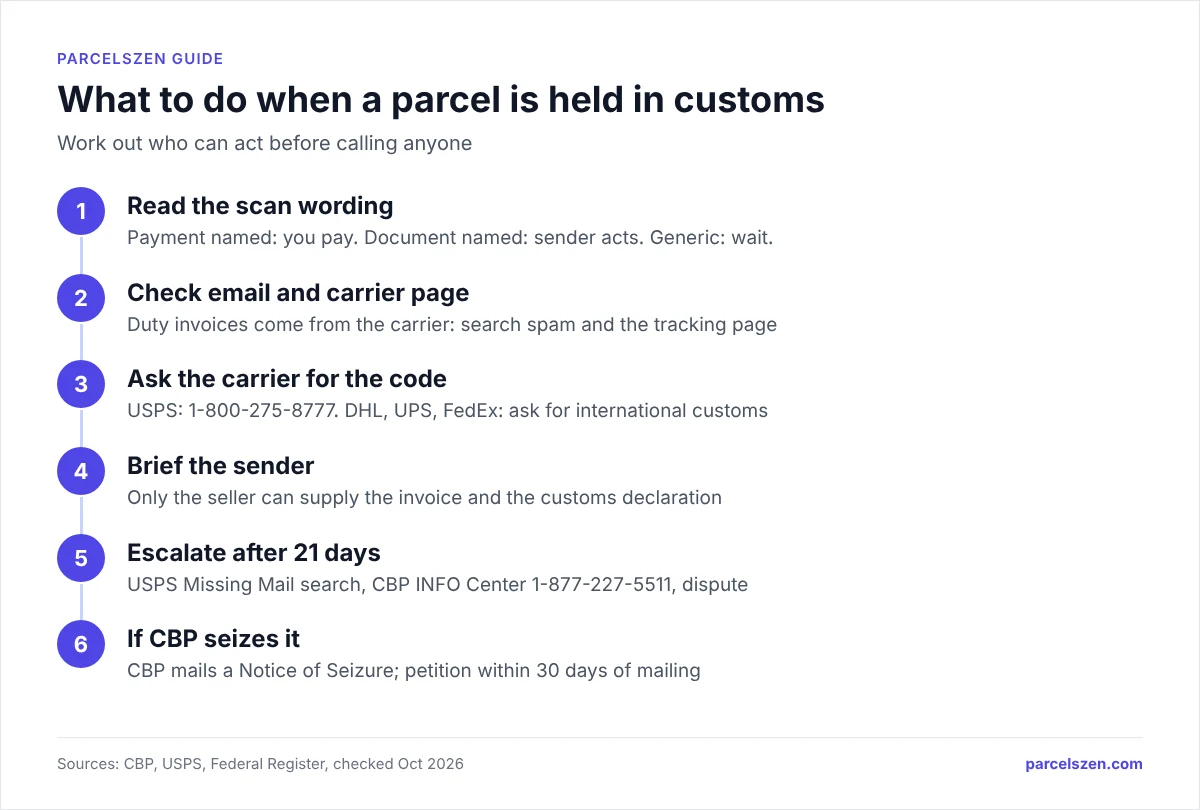
Step 1: Check Your Tracking Carefully for Clues
Sometimes the tracking message itself tells you why the package is held. Look for:
- 'Held by customs, contact CBP': A customs officer needs to reach you or the sender
- 'Duties owed, payment required': You need to pay import duties before the package can be released
- 'Additional documentation required': The party named on the shipping documents must supply it, usually the seller; if the carrier asks you, send your order confirmation as proof of purchase
If the message is just 'In customs' or 'Clearance in progress', there is likely no action required, because the package is simply in queue.
The wording of the scan tells you which of the five it is. Customs reason codes are terse, and carriers pass them through with minimal translation, so the exact phrase matters more than it looks.
Anything naming a payment, such as duties owed, charges due or an import invoice, is yours to clear and clears the moment you pay. Anything naming a document, such as additional information required or clearance information needed, is usually the sender's to clear, unless the carrier's request is addressed to you. Anything generic, such as in customs or clearance in progress, is the queue, and there is nothing to act on at all.
Screenshot the scan with its timestamp. UPS, for example, notes the reason for an exception in the Shipment Progress section of its tracking page, but the wording of a customs event can be brief. If you later need to claim, a dated screenshot turns a described problem into a documented one.
Step 2: Check Your Email
DHL, FedEx, and UPS will email you if they need payment or documentation for customs clearance. Check your spam folder too.
USPS is less proactive about this, so packages held for duties may not generate a notification.
CBP itself may send a Form CF-28 or CF-29 to your address if they need more information (this is rare for personal packages).
Track Your Package Through Customs
See the tracking updates for your parcel, including customs events when the carrier reports them.
Track Your PackageThe request usually goes to the sender, not to you. Customs and the broker contact whoever appears on the shipping documents, and on a marketplace order that is the seller, not the buyer. You can wait for an email that was never addressed to you.
Where the message actually lands when it is yours: duty invoices arrive from the carrier rather than from customs, often from an address that looks commercial, and spam filters can catch them. Search your spam folder for the carrier name and for your tracking number specifically, rather than scanning by eye.
Some carriers do not email at all. DHL, UPS and FedEx frequently post the duty invoice only inside their own tracking page or app, with a payment button that never appears in your inbox. If the scan says a payment is owed and no email exists, open the tracking page itself and look for a charges or payment tab.
Step 3: Contact the Carrier
For packages arriving via USPS:
Call 1-800-275-8777 (Monday to Friday 8 AM to 8:30 PM ET, Saturday 8 AM to 6 PM ET, as of October 2026) and give your tracking number. Ask: "Is my package being held by CBP, or is it in general USPS processing?"
For packages arriving via FedEx, DHL, or UPS:
These carriers have dedicated customs teams. Call their main customer service numbers and ask for the 'international customs' department. Having your tracking number, the sender's country, and the declared value ready will speed up the call.
Ask for the reason code, not for an update. Front-line agents can read the customs entry and tell you which of the five categories applies, and that single answer determines whether there is anything for you to do. Asking where the parcel is produces the tracking page you already have.
The three questions worth asking, in this order: what reason code is on the entry, is any payment outstanding on the account, and has any information been requested from the shipper. Those three cover every actionable hold, and an agent can answer all of them from one screen.
Escalating to a supervisor rarely helps on a customs hold, because the carrier is not the decision maker. Where it does help is with a broker who has not filed, and the useful phrasing is to ask whether the entry has been submitted to customs or is still with their brokerage team. Those are different delays with different owners.
Step 4: Contact the Sender
The seller, whether an AliExpress seller, a UK Etsy shop or any other international retailer, has responsibilities in the customs process. The accuracy of the customs declaration form (CN22 or CN23) is critical.
Ask the seller:
- Did they complete the customs form accurately?
- Is the declared value correct?
- Can they provide a commercial invoice or proof of purchase?
An incorrect or incomplete customs declaration is one of the most common reasons packages are held. Some sellers mark low values to avoid duty, and that triggers scrutiny which can cause delays even for legitimate packages.
On a document hold this is the only step that works, and every day spent on the carrier first is a day lost. The sender holds the commercial invoice, the value declaration and the harmonised code. You hold none of them unless the carrier asks you for proof of purchase.
Give the seller the reason code and the broker reference, not the tracking number. Sellers dealing with high volume treat a tracking number as a status request and reply with the same tracking page. A reason code plus a broker reference is a work item, and it reaches whoever handles their clearance queries.
Set a deadline in the message and mean it. Marketplace claim windows keep running while a parcel sits in customs, and a seller promising to look into it is not the same as a seller filing paperwork. Ask for confirmation within three business days that documents have been submitted, and open a dispute if that date passes.
Step 5: When to Escalate to a Formal Complaint
If your package has been in customs for more than 21 days with no resolution:
- File a Missing Mail search with USPS at usps.com/help/missing-mail.htm (requests open 7 days after mailing)
- File a complaint with the CBP Information Center at 1-877-227-5511 (Monday to Friday, 8:30 AM to 5 PM ET, as of October 2026) or online at help.cbp.gov
- Open a buyer dispute on the platform you purchased from (AliExpress, eBay, Etsy). The platform's buyer protection program may refund you even if the package is ultimately seized.
Escalation works when it is aimed at whoever is actually stalled. A parcel held for inspection is not stalled by anyone and no complaint will move it. A parcel waiting on a broker who has not filed, or a seller who has not answered, is stalled by a person, and that is where pressure produces movement.
The three routes, and what each one can do. A CBP Information Center enquiry can confirm whether an entry exists and what it is waiting on. A USPS Missing Mail search creates a formal record for a postal parcel that has stopped scanning. A marketplace dispute recovers your money, which is a different outcome from recovering the parcel and often the faster one.
Open the marketplace dispute even if you still expect the parcel. It preserves your position while the customs situation resolves, and it can be withdrawn if the parcel arrives. A claim filed after the window closes is refused, and windows differ: eBay's runs 30 calendar days from the estimated delivery date, and PayPal's 180 days from the date you paid (as of October 2026).
What Happens If Customs Seizes Your Package?
If CBP seizes your package, you'll receive a Notice of Seizure letter from CBP by mail. You have 30 days from the mailing date to file a petition, or 35 days to file a claim where the notice offers one.
- For packages containing prohibited items (counterfeits, drugs, unauthorized food products): seizure is permanent
- For packages held due to duty non-payment or documentation issues: you can usually get the package released by resolving the underlying issue
Frequently Asked Questions
Track Your Package Through Customs on ParcelsZen
Track your customs status on ParcelsZen to see the tracking updates, including customs events when the carrier reports them. If the scan names a payment or a document, act the same day; if it only says 'In customs' or 'Clearance in progress', check again after a week.
- 1-3 days in customs: Normal, no action needed
- 4-9 days: Monitor tracking for messages requiring action
- 10-20 days: Call carrier, check email for duty/document requests
- 21 days or more: File Missing Mail, call CBP at 1-877-227-5511 (weekdays)
- Seized? Notice of Seizure: 30 days from mailing to petition
Work out which of the five holds you have before doing anything else. Two of them cannot be influenced by anyone, one is yours to clear in minutes by paying an invoice, one belongs entirely to the sender, and one is already decided. That single question determines whether there is any useful action at all.
The most common mistake is spending the first week on the carrier. On a document hold the carrier can do nothing, the sender can do everything, and the marketplace clock is running the whole time. Contacting the right party on day two rather than day nine is usually the difference between a parcel that arrives and a refund that had to be claimed.
Sources
Official pages this guide relies on, checked in October 2026.
- Contact Us (U.S. Customs and Border Protection)
- Contact Us | USPS (United States Postal Service)
- Missing Mail and Lost Packages | USPS (United States Postal Service)
- Agency Information Collection Activities: Request for Information (CBP Form 28) (Federal Register / U.S. Customs and Border Protection)
- FAQs – Duties and Taxes (DHL Express (US))
- eBay Money Back Guarantee policy (eBay)