
International sellers routinely quote the best-case transit time. By this guide's estimates, a listing that says '7-15 days' can take 15-30 days door to door once the handoff and US customs are added. This guide gives ParcelsZen's estimated ranges, country by country and carrier by carrier, and names the carrier's own published delivery standard where one exists.
This country-by-country guide gives you honest, realistic expectations based on actual shipping data, not the optimistic estimates often shown at checkout.
Enter your tracking number on ParcelsZen for updates from any country. ParcelsZen covers 1,000+ carriers through our tracking data providers.
Shipping from China to USA
- Economy (China Post, ePacket, Cainiao Economy): 15-45 days, the most variable range (ParcelsZen estimate, October 2026)
- Standard (Yanwen, 4PX, Cainiao Standard): 10-25 days
- Express (DHL Express, FedEx, UPS, China EMS): 3-7 business days
China is the most common international origin for US online shoppers, and the lane behind AliExpress, Temu and SHEIN orders.
Which carrier you get is decided by the seller, not by you. Cheap listings ship on postal or consolidator services; anything marked express moves on a single company end to end. The consolidators are the ones people find confusing, because the parcel changes hands at least twice: a Chinese consolidator flies it out, US customs assesses it, and USPS or a regional courier delivers it.
Identifying what you have from the number: China Post issues a UPU-style number ending in CN, Yanwen uses Y plus nine digits then CN, Cainiao uses LP plus fourteen digits, and some consolidator numbers start with YT followed by 16 digits, a format no carrier publishes on its own site. Knowing which one you are holding tells you which site will actually have scans.
What goes wrong on this lane is almost always the handoff rather than a loss. A week of silence after the last China scan is the parcel sitting between two carrier systems, and it resolves on its own once the US carrier enters it. Economy shipments from China now also carry a duty assessment step that did not exist before 2025, which adds days and sometimes a bill.
Practical advice: on anything you actually need by a date, pay for express. The gap between 3-7 days and 15-45 days is the difference between one carrier and three.
Shipping from UK to USA
- Economy (Royal Mail International Standard): 7-21 days
- Standard Tracked (Royal Mail International Tracked): 7-10 business days
- Express (DHL, FedEx, UPS): 2-4 business days
The UK-to-USA route is well served from both ends, with Royal Mail handing to USPS on postal services and the integrators running their own networks door to door.
US customs processing added a modest delay at the border, typically one to three extra days, because UK exports to the US now clear without the $800 duty-free exemption, with fuller documentation than before. It is a paperwork cost rather than a physical one, which is why express services absorbed it more easily than postal ones.
Tracking: Royal Mail international items carry a UPU-style number ending in GB. Once the parcel is handed to USPS, that same number usually continues to work on the USPS site, which makes this one of the easier lanes to follow end to end.
Where it slips: International Standard is untracked beyond dispatch, so a parcel sent that way genuinely cannot be followed and the 7-21 day window is a guess rather than a promise. If the seller offers International Tracked for a few pounds more, take it. On higher-value items the difference matters again at the border, because a documented shipment clears faster than a sparse one.
Practical advice: this is a lane where the mid-tier service is the sweet spot. Tracked sits close to express on reliability at a fraction of the cost.
Shipping from Germany to USA
- Economy (Deutsche Post): 10-21 days
- Standard Tracked: 7-14 days
- Express (DHL Express, FedEx): 2-4 business days
Germany is a major e-commerce hub, and DHL (which is based in Germany) provides excellent service on this route.
Germany is a major e-commerce hub, and DHL, headquartered there, gives this route unusually strong infrastructure at every service level.
The distinction that matters is DHL Express versus Deutsche Post. They share a brand and are not the same service. DHL Express is an integrator that carries the parcel itself and clears it through its own broker, landing in 2-4 business days. Deutsche Post economy is a postal service that hands off to USPS in the United States, and that handoff is where the 10-21 day range comes from.
Tracking: Deutsche Post international items use a UPU-style number ending in DE. DHL Express numbers are 10 digits with no letters, and DHL Parcel uses JJD followed by seventeen digits. A number that fails on the DHL Express site is usually a Deutsche Post number, and belongs on the postal tracker instead.
What to expect at the border: Since 29 August 2025 every parcel from Germany needs a US customs entry. Deutsche Post requires business senders to prepay US duty on goods up to $2,500, while private gift parcels up to $100 are exempt. Where this lane slows down, the cause is normally a duty assessment rather than an inspection.
Practical advice: if a listing says DHL, check which DHL before assuming a 3-day delivery.
Shipping from Japan to USA
- Economy (Japan Post economy mail; since 14 April 2026 the sender must prepay US duty): 14-30 days
- Standard (Japan Post Air Parcel): 6-12 days
- Express (EMS Japan, FedEx, DHL): 2-5 business days
Japan Post is known for excellent tracking quality at all service levels. EMS Japan is often the preferred choice for Japanese sellers because it provides fast delivery with reliable tracking at a fraction of private courier costs.
Track Your International Package Now
Enter any international tracking number for updates from 1,000+ carriers.
Track Your PackageJapan Post is known for excellent tracking quality at all service levels, and it is the reason this lane feels more predictable than its transit times suggest.
EMS Japan is often the preferred choice for Japanese sellers because it provides fast delivery with reliable tracking at a fraction of private courier costs. For most consumer purchases it is the service worth paying for, and it usually lands inside the express band without an express price.
Economy mail is the one to avoid if timing matters. Economy mail moves as cargo space allows rather than on a booked flight, which is why its 14-30 day window is so wide. The parcel is not lost during a long economy mail gap; it is waiting for capacity.
Tracking: Japan Post uses a UPU-style number ending in JP, and scans continue after the USPS handoff on most services, so a single number follows the whole journey.
Where this lane surprises people: Japanese sellers often declare contents precisely and value honestly, which speeds clearance but means duty is assessed on the real figure. Collectibles, hobby goods and used items are the categories most likely to attract an assessment.
Practical advice: choose EMS over economy mail unless the price gap is large and you genuinely do not care when it arrives.
Shipping from South Korea to USA
- Economy (Korea Post): 10-25 days
- Standard (Korea Post EMS): 5-10 days
- Express (FedEx, DHL): 2-4 business days
K-beauty, fashion, and tech products often ship from Korea. EMS Korea is the most common tracked service for consumer goods.
K-beauty, fashion and tech products often ship from Korea, and EMS Korea is the most common tracked service for consumer goods.
Korea Post runs one of the better-scanned postal networks into the United States. EMS Korea behaves close to an express service on timing while remaining a postal product, which means it hands to USPS for final delivery but does so quickly and with the handoff visible in tracking rather than silent.
The economy tier is a different experience. Standard Korea Post at 10-25 days carries fewer scans and a longer quiet stretch mid-journey, so the same origin can feel reliable or opaque depending purely on which service the seller chose.
What to watch at the border: cosmetics and skincare are the most-shipped category on this lane and also the one most likely to be referred, because personal-care products can fall under other agencies' rules.
Practical advice: if the seller offers EMS, take it. The premium over standard is usually small and it buys both speed and visibility.
Shipping from Australia to USA
- Economy (Australia Post): 10-20 days
- Express (DHL, FedEx): 3-5 business days
The distance adds time, since Australia is 14,000+ km from the US East Coast, but the Australia Post to USPS route is reliable.
The distance adds time, since Australia is 14,000+ km from the US East Coast, but the Australia Post to USPS route is reliable and well scanned.
Distance rather than process is the constraint here. There is no customs complication specific to this lane and no consolidator layer to lose the parcel in. What you are paying for with express is a booked flight; economy waits for cargo space, and that wait is most of the 10-20 day range.
Tracking: Australia Post international items carry a UPU-style number ending in AU, and the number normally continues to scan after the USPS handoff.
Seasonal effect worth planning around: the Australian and US retail calendars are offset, so this lane is least congested during the northern summer and most congested in the run-up to Christmas, when both ends are busy at once. A parcel that takes ten days in July can take three weeks in December on exactly the same service.
Practical advice: for anything time-sensitive from Australia, book express and book it early. Economy is genuinely fine when the date does not matter, and genuinely unpredictable when it does.
Shipping from India to USA
- Economy (India Post): 15-35 days
- Express (FedEx, DHL): 4-7 business days
Indian customs processing can occasionally add delays, particularly for textile goods.
Indian customs processing can occasionally add delays, particularly for textile goods, and origin-side handling is the defining feature of this lane.
The delay usually happens before the parcel leaves India rather than on arrival. Export clearance, documentation checks and onward routing at the origin account for much of the 15-35 day economy window, which is why the range is wide even when nothing has gone wrong. Once a parcel is airborne, the US leg behaves like any other.
Textiles are the category to watch. Garments and fabric attract higher duty rates than most consumer goods and are more likely to be examined, so a clothing order from India is both slower and more likely to carry a charge than an equivalent order of, say, books or handicrafts.
Tracking: India Post uses a UPU-style number ending in IN. Scan frequency on the Indian side is lower than on Japanese or Korean services, so a gap of several days without an update is normal rather than a warning.
Practical advice: for anything valuable or time-sensitive, express with FedEx or DHL is worth the premium here more than on most lanes, because it bypasses the origin-side handling that causes most of the variability.
Shipping from Canada to USA
- Economy (Canada Post Small Packet USA Air): 5-8 business days (Canada Post delivery standard)
- Standard (Canada Post Tracked Packet USA): 4-7 business days (Canada Post delivery standard)
- Express (UPS, FedEx): 1-3 business days
The proximity means Canada-to-USA shipping is typically one of the fastest international routes available.
The proximity means Canada-to-USA shipping is typically one of the fastest international routes available, and the shortest handoff of any origin.
Canada Post's own delivery standards to the US are 5-8 business days for Small Packet USA Air and 4-7 for Tracked Packet USA, so the gap between economy and express is narrower here than on any other lane in this guide.
Tracking: Canada Post international items use a UPU-style number ending in CA, and the number continues to work after the USPS handoff on tracked services.
The customs point people get backwards: the CUSMA trade agreement does not make goods duty-free simply because they were posted from Canada. What matters is where the item was manufactured. A Canadian-made item may qualify for preferential treatment; a Chinese-made item bought from a Canadian retailer generally does not, and is assessed on its actual origin.
Practical advice: economy is genuinely good on this lane. Paying for express buys one or two days, not two weeks.
The three parts of an international delivery
A quoted transit time usually describes one leg of the journey. The number that matters to you is the sum of three, and only the first is what the seller advertises.
| Component | Typical duration | Who controls it |
|---|---|---|
| Carrier transit | The advertised figure | The carrier |
| The handoff | 2 to 10 days, often silent | Nobody, it falls between two systems |
| Customs clearance | Hours to several days | The destination authority |
🚚 Carrier transit
🔀 The handoff
🛃 Customs clearance
The handoff is the part nobody warns you about. An international parcel changes companies at least once: the origin carrier flies it out, and a destination carrier delivers it. Between the last origin scan and the first destination scan the parcel is real, moving, and invisible. On economy services from Asia that gap routinely runs a week.
It is also why a parcel can appear stuck without being stuck. Silence during the handoff means the parcel has left one system and has not yet been entered into the next, which is a bookkeeping gap rather than a physical one.
The United States suspended its $800 duty-free de minimis allowance for China and Hong Kong on 2 May 2025 and for all countries on 29 August 2025, and CBP made the suspension indefinite for courier, freight and mail shipments in rules published on 24 June 2026 (status as of October 2026). Several postal operators, including Royal Mail, Japan Post and Deutsche Post, now make the sender prepay US duty on goods. Previously most consumer parcels passed through without assessment. Now every inbound parcel is assessable, which means clearance is a step on every shipment rather than an occasional one. Build the extra days into your expectation regardless of order value.
Realistic door-to-door totals by origin
The figures below add the handoff and a clearance allowance to the carrier transit times in each country section. Economy figures assume a postal handoff, which is where the silence occurs. Express services move through a single company end to end, which is most of why they cost more.
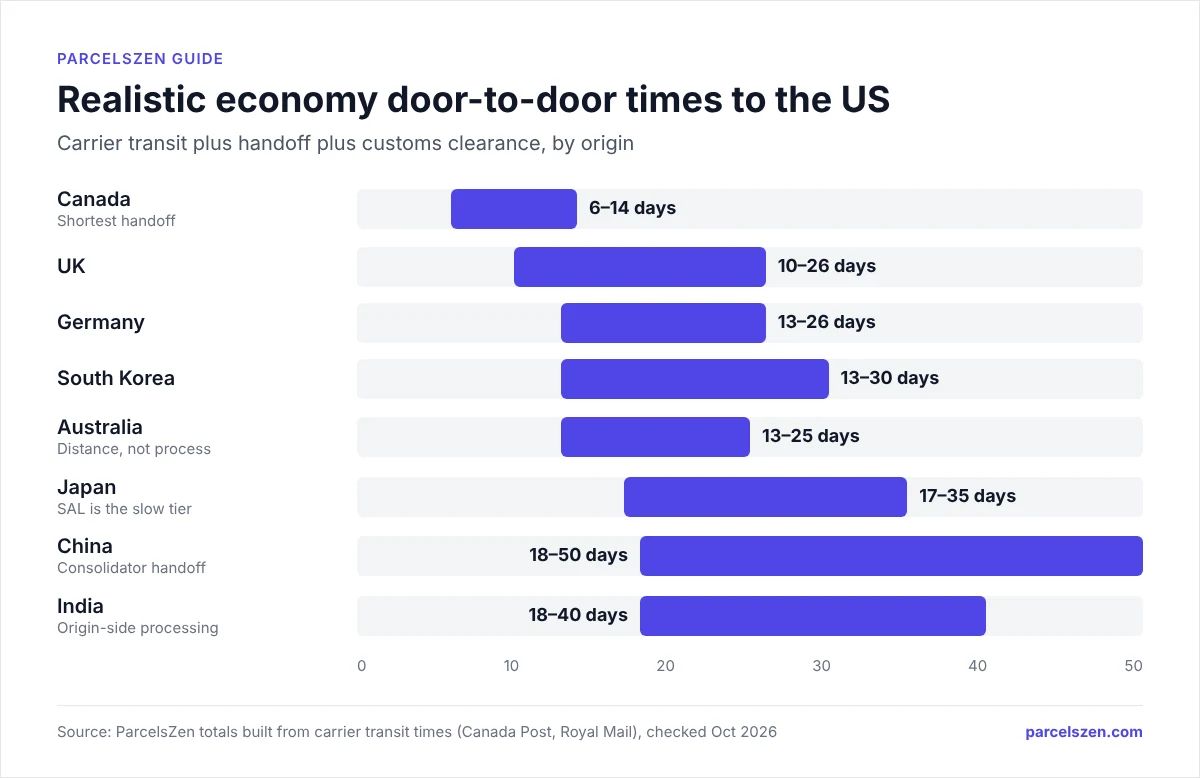
| Origin | Economy, realistic | Express, realistic | Main variable |
|---|---|---|---|
| Canada | 6 to 14 days | 1 to 4 days | Shortest handoff of any origin |
| UK | 10 to 26 days | 2 to 5 days | US border processing |
| Germany | 13 to 26 days | 2 to 5 days | Strong carrier infrastructure |
| South Korea | 13 to 30 days | 2 to 5 days | EMS handoff is fast and well scanned |
| Australia | 13 to 25 days | 3 to 6 days | Distance, not process |
| Japan | 17 to 35 days | 2 to 6 days | Economy mail is slow, EMS is not |
| China | 18 to 50 days | 3 to 8 days | Consolidator handoff plus origin measures |
| India | 18 to 40 days | 4 to 8 days | Origin-side processing |
⚡ Fastest origins
🐢 Slowest origins
✈️ Express, any origin
Read the spread rather than the midpoint. Canada and China both have a floor that looks reasonable, but China's ceiling is almost three times its floor because a consolidator handoff can add a week on its own. On any economy service the upper end is the number to plan around.
Why Advertised Times Differ From Reality
Online sellers routinely advertise shipping times at the optimistic end of the range. 'Ships in 7-15 days' often means 15-30 days in practice.
Always read actual buyer reviews mentioning delivery times, and factor in potential customs holds (1-5 days typical). For time-sensitive purchases, always pay for tracked express service rather than relying on economy options.
Frequently Asked Questions
Holiday Season Impact on International Shipping
From November through January, plan around the upper figure of each range in this guide. If you need something by Christmas and it's shipping from China, October is your real deadline, not November.
- Express services: Less affected but can still add 2-4 days
- Order international gifts: By late October or early November to avoid disappointment
Track your international package on ParcelsZen. Enter any tracking number for updates from 1,000+ carriers.
Two habits will save you most of the frustration on any of these lanes. The first is to read the spread rather than the midpoint: an economy service quoted at 15-45 days is telling you that the upper number is a real possibility, not a worst case that never happens. The second is to find out whether your parcel travels on one carrier or several, because a single-carrier express shipment behaves completely differently from a postal one that changes hands twice.
Silence in the middle of a journey is the normal state of an international parcel, not evidence that something has failed. The handoff between the origin carrier and the destination carrier produces a gap in scanning on almost every economy service, and it resolves itself. The situations genuinely worth acting on are a parcel that never receives a first scan at all, and one held at the border pending a payment you have not been told about.
Sources
Official pages this guide relies on, checked in October 2026.
- Indefinite Suspension of the De Minimis Exemption for Merchandise Arriving Through All Modes Other Than the International Postal Network (91 FR 37789) (Federal Register / U.S. Customs and Border Protection)
- Suspending Duty-Free De Minimis Treatment for All Countries (Executive Order 14324) (The White House)
- International Tracked | Royal Mail (Royal Mail)
- Sending items to the USA? Royal Mail has changed its services to the USA (Royal Mail)
- Ship small parcels to the U.S. | Personal | Canada Post (Canada Post)
- Ship small items to the U.S. for less | Personal | Canada Post (Canada Post)
- Track and Trace Your Express Shipment | DHL Malaysia (DHL Express)