
DHL operates in over 220 countries and territories. For international packages, DHL Express is usually the fastest tracked option, and its tracking shows each scan as DHL records it. The status messages are terse, but each one tells you something specific.
You can track any DHL package on ParcelsZen. Enter your tracking number to see the latest DHL scans.
DHL Services: Express vs. eCommerce vs. Parcel
DHL Express
The premium division offering door-to-door international express delivery in 1-5 business days. Tracking numbers are 10 digits.
DHL eCommerce
A lower-cost service for e-commerce businesses, especially from Asia. Transit times are 7-21 days. Tracking numbers often start with GM, LX, RX, AU or TH.
DHL Parcel
Operates mainly in Europe for domestic and regional parcel delivery.
DHL Express and DHL eCommerce are different services
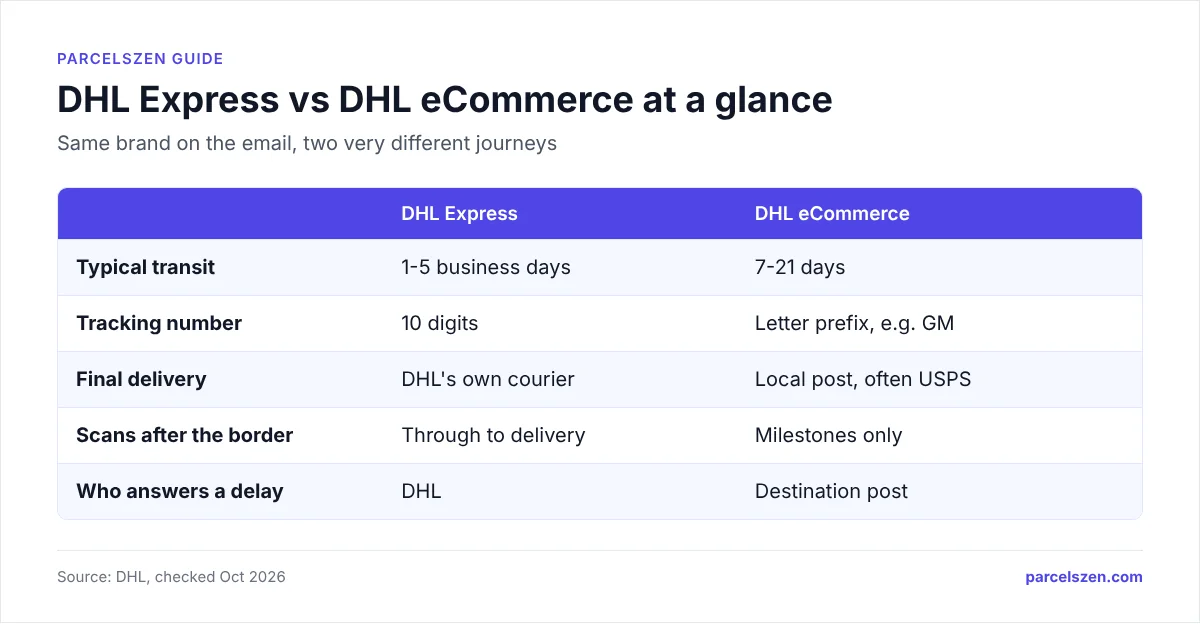
This is the distinction that causes most DHL confusion, and almost no guide explains it. DHL Express is an integrator: it collects the parcel, flies it on its own network, clears it through its own brokers and delivers it. Nobody else touches it, which is why it moves in days and why it costs what it costs.
DHL eCommerce is a different proposition entirely. It is an economy service that carries the parcel internationally and then hands it to a local postal operator for the final leg. In the United States that is usually USPS. The DHL brand on your confirmation email does not mean a DHL van will arrive.
The practical test is the transit time you were quoted. A window measured in days is Express. A window measured in weeks is eCommerce, and the parcel will finish its journey with your national post regardless of what the tracking page says at the start.
Which of these you actually get is decided by the seller, not by you. A US buyer ordering from a European or Asian shop almost never sees the service name at checkout, only a price and an estimated window. That is why the tracking number and the transit estimate are the two reliable signals, and why asking the seller before dispatch is the only point at which the choice can still change.
The practical split for anything shipped to the United States is between a service DHL carries to your door and one it hands to USPS partway. Everything below follows from that single difference, and the next section is where it matters.
Which DHL Number Do You Have?
DHL Express numbers are 10 digits with no letters. If your number fails on dhl.com it is almost certainly not Express, and a number ending in DE was issued by Deutsche Post in Germany, and DHL routes it to DHL Parcel tracking rather than Express. Our tracking number formats guide has the full reference for every DHL and Deutsche Post pattern.
Four formats travel under the DHL name, and the column that matters is the last one: which site will actually recognise your number. A valid number entered on the wrong tracker returns no result, which can look like a lost parcel.
| What you are holding | Example | Where it actually resolves |
|---|---|---|
| DHL Express: 10 digits, no letters | ########## (10 digits) | dhl.com, from the first scan |
| DHL Parcel: JJD + 17 digits | JJD################# | dhl.com, mainly European routes |
| DHL eCommerce: 10 to 39 characters, often starting GM, LX, RX, AU or TH | GM + digits | dhl.com early, then the destination post |
| Deutsche Post: 2 letters + 9 digits + DE | XX#########DE | Deutsche Post item. Track on dhl.com as DHL Parcel |
✈️ DHL Express
📦 DHL Parcel and eCommerce
🇩🇪 Ends in DE?
A waybill number is the same thing as a tracking number on DHL Express, so if a seller sends you a "waybill" of ten digits, that is your number and dhl.com will accept it.
What to do when the number returns nothing. A failed lookup on dhl.com almost never means the parcel is lost. Work through it in this order: confirm the number is 10 plain digits, because anything longer is a different service; wait 24 to 48 hours after the shipping email, since the label is created before DHL physically has the parcel; then try the destination country postal site, because on an eCommerce shipment the parcel may already have been handed over and left DHL's system entirely.
Who Actually Delivers It, and Why That Changes Everything
This is the question the DHL brand hides. Two parcels can both say DHL on the confirmation email and arrive by completely different routes, with different people, on different timescales, and with a different company answering the phone when something goes wrong.
DHL Express: one company, door to door
DHL Express is an integrator. It collects the parcel, carries it on its own aircraft, clears it through its own customs brokers and delivers it with its own driver in a yellow van. Keeping the parcel in one network is what you are paying for, and it is why Express tracking shows each hub and customs step under one waybill number.
DHL eCommerce: DHL flies it, someone else delivers it
DHL eCommerce carries the parcel internationally and then hands it to a local postal operator for the final leg. In the United States that is usually USPS. Your parcel travels most of its journey with DHL and finishes it in a USPS truck, delivered by a USPS carrier, on USPS timings.
That is why a DHL-branded order can arrive in a USPS vehicle, and why the delivery scan on a DHL parcel sometimes says something no DHL system generated. Nothing has gone wrong. The handoff is the service you bought.
How to tell which one you have before it ships
- The quoted transit time is the clearest signal. A window measured in days is Express. A window measured in weeks is eCommerce.
- The number format confirms it. 10 plain digits is Express. Anything longer, or with a letter prefix, is not.
- The price the seller charged. Express is DHL's premium service, so a cheap or free international shipping option is rarely Express.
- Ask before dispatch, not after. The service is fixed when the label is bought and cannot be upgraded once the parcel is moving.
Why "my DHL package is delayed" means two different things
On Express, a delay is DHL's to explain. The parcel is in DHL's custody from collection to delivery, so DHL can see it, can tell you where it is, and is accountable for the stall. More than two working days without a scan is genuinely unusual and worth a call.
On eCommerce, a delay is often nobody's to explain. The parcel may already have left DHL entirely. Once it is handed to the local post, DHL's tracking stops receiving detail and DHL's support cannot see beyond the transfer, because the parcel is no longer in its system. A week of quiet during that transfer is the normal shape of the service.
Can tell you: that the parcel left DHL, the date it was transferred, and which destination operator received it.
Cannot tell you: where it is now, when it will arrive, why it has stopped, or arrange a redelivery. Those answers live with the receiving carrier. If your last DHL scan reads as a transfer or a handover, take the same number to the destination postal service instead of calling DHL again.
DHL Tracking Status Guide
'Shipment information received'
DHL has the data but the package may not be collected yet. Wait 24-48 hours.
'Shipment picked up'
First confirmed physical scan, so DHL has the package.
'In transit'
Package moving through DHL's network, typically involving a flight through a hub.
'Customs clearance'
Package being processed by customs. If customs needs documents from the receiver or importer, the parcel can wait in bonded storage until they arrive.
'Clearance processing complete'
Customs cleared. Delivery expected within 1-2 business days.
'With delivery courier'
DHL driver has the package on their route. Expect delivery today.
'Delivered – Signed for by [name]'
Package delivered with signature. DHL Express requires signatures for most packages.
Two of these statuses look like problems and are not. "Shipment information received" simply means the seller generated a label; the parcel may still be on a shelf, and it is the status most often mistaken for a dispatched package. "Customs clearance" is a routine step on every international shipment rather than a sign that yours was singled out.
The status that should prompt action is a missing one. If a number never progresses past information received after three business days, the parcel has not been handed to DHL and the seller is the person to contact. DHL cannot investigate a shipment it has never physically received.
Signature requirements catch people out on Express. DHL Express requires a signature on most shipments, so an unattended delivery will not simply be left at the door. If you will be out, DHL On Demand Delivery lets you redirect to a neighbour, a service point or a different day before the first attempt rather than after it.
On DHL Express, more than two working days without a scan is unusual and worth a call. On DHL eCommerce, a week of silence during the handoff to the local carrier is normal and resolves on its own. The service you are on decides whether the same silence is a warning or routine.
Track Your DHL Package Now
Tracking updates from DHL Express, eCommerce, or Parcel.
Track DHL PackageDHL Transit Times by Route
- DHL Express, most routes: next possible business day for most international shipments, according to DHL; times vary by origin, destination and service
- China to USA: Express as above, eCommerce in weeks (see the seller's estimate)
DHL eCommerce from China takes weeks because it uses economy routing, not DHL's express network. Check which service your seller is using before ordering.
The Express times above count from collection, not from checkout. Seller processing commonly adds one to three days before the first scan appears, and on eCommerce services the same lanes take weeks.
The routes differ by more than distance. China to the US is the one route on the list where the choice between Express and eCommerce changes the answer from days to weeks.
Customs is a separate variable from transit. A parcel that flies in two days can still sit for another day or two at the border, and since the United States suspended its duty-free allowance, assessment now applies to inbound parcels generally rather than to a minority. Build that into your expectation rather than treating the quoted transit time as the delivery date.
DHL Customs and Duties
- USA: the $800 duty-free allowance ended for shipments from China and Hong Kong on 2 May 2025 and for all countries on 29 August 2025 (Executive Order 14324). A CBP interim final rule of 24 June 2026 made the suspension indefinite for non-postal shipments such as DHL Express, and the statutory exemption is repealed from 1 July 2027, so inbound parcels are assessable regardless of value
- DHL advances any duty at the border and bills you separately, usually adding its own handling fee
- If held, you may receive a request for commercial invoice or proof of purchase
DHL Express has dedicated customs teams that can advance US duties and taxes so a parcel keeps moving, then bill the receiver with a processing charge on non-document imports.
The brokerage fee is the part people do not expect. DHL pays the duty at the border so the parcel keeps moving, then invoices you for the duty plus its own handling charge. That charge is commercial rather than governmental, which is why it varies between carriers and why a small parcel can attract a fee larger than the duty itself.
What actually causes a hold. A vague description on the customs form gives the authority nothing to classify, and a declared value that does not match the contents invites a closer look. Both sit with the sender rather than with you, which is why asking a seller to describe goods accurately is the single most useful thing you can do before dispatch.
If DHL asks for documents, respond quickly. The clock stops until you reply, and the request is sent to the contact details on the shipment, which may be the seller rather than you. An unanswered request can sit for weeks with neither party realising the parcel is waiting on them.
What to Do If Your DHL Package Is Delayed
- Check ParcelsZen or DHL tracking for any exception messages
- Weather, high volume, or customs holds typically resolve within 1-3 days
- For DHL Express: call 1-800-225-5345 (USA) for support Monday to Friday, 6 AM to 7 PM Arizona time
- If a guaranteed delivery date was missed, request a refund from DHL or your seller
Work out which service you are on before you escalate, because the same delay means different things. On DHL Express the network is DHL's from end to end, so a genuine stall is DHL's to explain and the DHL Express line can see the parcel. On DHL eCommerce the parcel may already have left DHL entirely, in which case DHL has nothing left to tell you and the destination carrier is the one holding it.
Check the last scan location before calling. If the most recent event is in the destination country, the parcel has cleared the international leg and any remaining delay is domestic. If the last scan is still at an origin or transit hub after several days, that is the case worth raising, and quoting the exact scan gets you past the first line of support faster than describing the problem.
DHL Express offers a money-back guarantee on many international express services, but it is time-limited and has to be claimed rather than issued automatically. Where the shipment was paid for by a seller, the seller is the contract holder and the one who has to file, so raise it with them in the first few days rather than waiting to see whether the parcel arrives.
One thing worth ruling out early: a parcel held for payment is not a delayed parcel. If DHL has advanced duty at the border and the invoice has not been paid, the shipment sits and tracking often shows nothing more informative than a hold. Check your email, including spam, before assuming the parcel is stuck in transit.
Frequently Asked Questions
Track DHL on ParcelsZen
Enter your DHL tracking number into ParcelsZen for tracking status across DHL Express, eCommerce, and Parcel. For packages stuck over 10 days internationally: call DHL at 1-800-225-5345 and ask specifically for the international customs team.
- Shipment information received: Label created, not yet with DHL
- Shipment picked up: DHL has the package, first real scan
- In transit: Moving through DHL network
- Customs clearance: Being processed at border, normal
- With delivery courier: On DHL truck today
- Delivered: Package arrived, signature obtained
Two questions settle almost every DHL situation. The first is which DHL you actually have, because Express and eCommerce are different services with different speeds, different tracking behaviour and different final-mile carriers. The number format answers it in seconds.
The second is whether the quiet period you are looking at is a handoff or a problem. On Express there is no handoff, so a genuine gap of several days is worth a call. On eCommerce the gap is built into the service and resolves itself when the destination carrier scans the parcel. Knowing which one you are on turns an alarming silence into an expected one.
Sources
Official pages this guide relies on, checked in October 2026.
- DHL Express - Fast. Door-to-Door. Courier Delivered - United States of America (DHL)
- FAQs – Tracking and Monitoring (DHL Express (MyDHL+))
- Tracking number not 10 digits (DHL Express (MyDHL+))
- Tracking and Shipment Status FAQ - DHL eCommerce - United States of America (DHL eCommerce)
- Customs services | DHL Discover (DHL)
- Contact DHL Express - DHL Express - United States of America (DHL)
- Fact Sheet: President Donald J. Trump Is Protecting the United States' National Security and Economy by Suspending the De Minimis Exemption for Commercial Shipments Globally (The White House)