
What is Customs Clearance?
Customs clearance is the mandatory process that all international packages must go through when entering a country. Think of it as the "immigration control" for packages - customs officers inspect shipments to ensure they comply with import laws, assess appropriate taxes and duties, and screen for prohibited or dangerous items.
Every country has its own customs authority (like U.S. Customs and Border Protection, HMRC, or Canada Border Services Agency) that enforces import regulations. When you order something from abroad, your package must clear customs before it can be delivered to you.
💡 Key Point
Customs clearance is not optional. Every international package - whether from China, the UK, USA, or anywhere else - must go through customs in the destination country. This applies to both commercial shipments and personal purchases.
The Customs Clearance Process
Understanding what happens during customs clearance helps set realistic expectations for international shipping times. Here's the typical step-by-step process:
Package Arrives at Customs
Your package arrives at the destination country's port of entry (airport or shipping port). You'll see tracking updates like "Arrived at Destination Country" or "Presented to Import Customs."
Documentation Review
Customs officers review the commercial invoice, customs declaration form, and shipping documents. They verify the declared value, item description, and sender/receiver information.
Physical Inspection (If Required)
Some packages are randomly selected or flagged for physical inspection. Officers may open the package to verify contents match the declaration. This doesn't mean there's a problem - it's routine.
Duty and Tax Assessment
Customs calculates import duties and taxes based on item type, value, and country of origin. Where a de minimis allowance still applies, a parcel under it is normally passed without assessment - but several destinations, including the United States, now assess parcels regardless of value. You'll receive a notice if payment is required.
Clearance and Release
Once approved and fees paid (if applicable), your package receives a "Customs Cleared" or "Released from Customs" status. It's then handed to the local postal service or courier for delivery.
⏱️ How Long Does Customs Clearance Take?
- Express shipments (DHL, FedEx, UPS): 1-2 business days
- Standard air mail: 2-5 business days
- Economy shipping: 3-10 business days
- Packages requiring inspection: 5-15 business days
Note: Times increase significantly during peak seasons (November-December) or global events.
Understanding Duties and Taxes
When you import goods, you may owe two types of fees:
Import Duties (Tariffs)
Import duties are taxes imposed on goods entering a country. The rate depends on:
- Product category: Electronics, clothing, cosmetics all have different duty rates
- Country of origin: Some countries have trade agreements that reduce or eliminate duties
- HS Code: Harmonized System code that classifies the product type
- Declared value: Higher value = higher duty
Example: If a $100 pair of shoes carries a combined duty rate of 20%, you owe $20 in duty, plus any import tax and the carrier's clearance fee. Rates change with trade measures, so look up the current rate for your product and its country of origin in your destination's tariff schedule before you buy.
Value-Added Tax (VAT) / Sales Tax
Many countries charge VAT or sales tax on imported goods. This is the same tax residents pay when buying domestically:
- European Union: Standard VAT rates 17-27% depending on country
- United Kingdom: 20% VAT on most goods
- Canada: 5% GST + provincial sales tax (varies by province)
- Australia: 10% GST
- United States: Customs duty can apply to parcels of any value since 29 August 2025, and some states, such as Hawaii, charge use tax on goods bought from sellers abroad
Handling/Processing Fees
Couriers and postal services usually charge their own fee for clearing a parcel through customs on your behalf. The amount depends on the carrier, the destination and the duty owed, and the carrier shows it on the payment notice before you pay.
⚠️ Important: You Are Responsible for Customs Fees
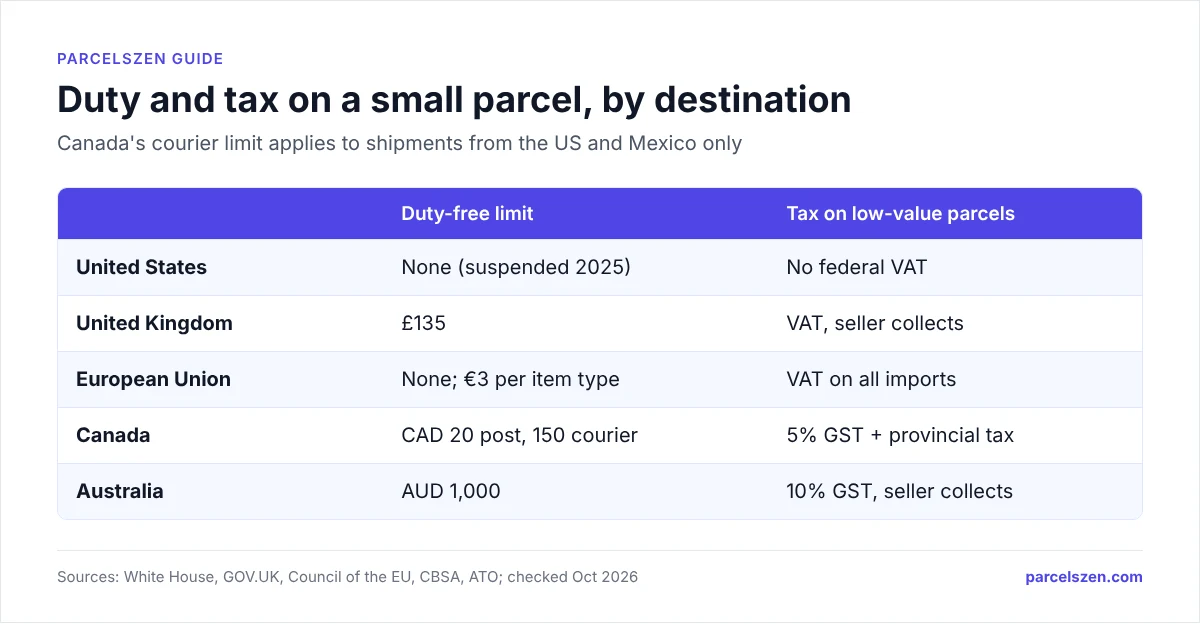
Unless explicitly stated as "DDP" (Delivered Duty Paid) by the seller, you (the buyer) are responsible for all customs duties and taxes. The exception is low-value import tax that the seller must charge at checkout: UK VAT on goods of £135 or less, and Australian GST on goods of A$1,000 or less. Duty and tax rates vary by destination and by what you ordered, so check your own country's rate before you buy - the table below is the starting point.
De Minimis Values by Country
"De minimis" is the value threshold a country uses to decide whether a parcel is assessed at the border. Where one still applies, a parcel under it usually clears quickly. Several destinations in the table below no longer work that way: the United States has suspended its allowance and assesses parcels regardless of value, the United Kingdom charges VAT on every item, and the European Union charges VAT on all imports.
| Country | De Minimis Value | Notes |
|---|---|---|
| United States | Suspended | Suspended for all countries from 29 August 2025 and made indefinite by CBP on 24 June 2026; parcels assessed regardless of value (as of October 2026) |
| Canada | CAD 20 by post / CAD 40 and 150 by courier | Three thresholds at once. Courier from the US or Mexico gets the higher CUSMA limits |
| United Kingdom | £135 | VAT charged on all items; no duty under £135 |
| European Union | €3 flat, per item category | The €150 duty relief ended 1 July 2026; the €3 interim duty runs to 1 July 2028 (as of October 2026); VAT on all imports since 1 July 2021 |
| Australia | AUD $1000 | Generous threshold; most personal items duty-free |
| New Zealand | NZD $1000 | Below it the overseas seller charges GST at checkout; Customs collects GST and duty at the border only above it |
| Singapore | SGD $400 | Duty-free for most personal items under threshold |
| Japan | ¥10,000 | Low threshold; frequent customs charges |
| South Korea | $150 | Reasonable threshold for personal purchases |
| Brazil | USD 50 band (rate set by decree) | Law 15.502 of 10 September 2026, which converted Provisional Measure 1.357, lets the Finance Minister cut the import tax on parcels up to USD 50 to zero. Check the current rate with Receita Federal before ordering (as of October 2026) |
💡 Pro Tip: Seller's Declared Value Matters
Customs bases fees on the declared value on the package, not necessarily what you paid. Some sellers undervalue packages to help avoid customs fees (this is technically illegal but common). However, if the package is lost or damaged, insurance only covers the declared value, so there are trade-offs.
Prohibited and Restricted Items
Certain items cannot be imported into most countries, while others require special licenses or permits. Packages containing prohibited items will be seized and may result in fines.
Commonly Prohibited Items
- Weapons and ammunition: Firearms, knives (in many countries), pepper spray, tasers
- Drugs and narcotics: Including some prescription medications not approved in the destination country
- Counterfeit goods: Fake designer items, pirated media, trademark violations
- Obscene materials: Pornography (varies by country), hate speech materials
- Live animals and plants: Without proper permits and quarantine clearance
- Hazardous materials: Explosives, flammable liquids, corrosive substances
- Currency and negotiable instruments: Large amounts of cash, unregistered securities
- Cultural artifacts: Items of historical significance without export permits
Commonly Restricted Items (Require Permits/Licenses)
- Food products: Meat, dairy, fruits, vegetables (strict agricultural laws)
- Supplements and vitamins: May require health authority approval
- Cosmetics: Must meet safety standards; some ingredients banned
- Electronics: Some countries restrict certain frequencies or encryption
- Alcohol and tobacco: Heavily taxed; quantity limits apply
- Batteries: Lithium batteries have shipping restrictions
- Pharmaceuticals: Even personal use quantities may require prescriptions
Where Buyers Actually Get Caught
The headline prohibitions rarely catch ordinary shoppers. Nobody orders explosives by accident. The seizures that hit normal orders come from four categories that look harmless on a product page.
Food, and the fact that no two countries agree on it. The same hamper is ordinary post into the UK, a biosecurity destruction order in Australia, and a partial seizure in Canada. The EU bars meat and dairy from outside the bloc outright while allowing the biscuits in the same box. Because customs treats a mixed parcel as one consignment, a single jar of honey can cost you the whole hamper rather than just the honey.
Lithium batteries, which are blocked before customs ever sees them. This is the one category on the list that fails at the airline rather than the border, so no customs authority is involved and no seizure notice arrives. The parcel simply never flies. A seller in China can accept the order, take payment, and find the power bank refused at the airport, which is why the phone case ordered alongside it arrives and the battery quietly does not.
Anything a doctor prescribes. Personal quantities still count. Many countries require the original prescription, and some ban specific compounds regardless of paperwork. Melatonin is sold openly in the United States and is prescription-only in the UK and Australia.
Replica and lookalike goods. Customs does not need proof you knew. A bag described as "inspired by" a designer label is a trademark violation at the border, and unlike other seizures this one can put your name on a record.
💡 Check before you order, not after
Every customs authority publishes its own prohibited list, and they disagree with each other more than you would expect. Knives are ordinary post in one country and a criminal matter in the next. Search the destination authority's own site for the item category before checkout. The five authorities covered on this page are CBP, HMRC, CBSA, the ABF, and the customs service of the specific EU member state you are importing into.
🚫 What Happens If You Import Prohibited Items?
- Package is seized and destroyed
- You receive a customs violation notice
- No refund from seller (not their responsibility)
- Possible fines, set by the destination country's customs law
- Criminal charges for serious violations (weapons, drugs)
Always research import laws before ordering internationally!
Why Packages Get Stuck in Customs
If your tracking shows "In Customs" or "Customs Clearance" for more than a week, here are the most common reasons:
1. Incomplete or Incorrect Documentation
Problem: Vague descriptions like "gift" or "toy" on customs forms, missing commercial invoice, incorrect HS codes.
Solution: Customs will contact you or the sender for clarification. Respond quickly with detailed information.
2. High Package Value
Problem: Higher-value packages receive more scrutiny and may require additional verification.
Solution: Keep receipts and proof of payment ready if customs requests verification.
3. Random Inspection
Problem: Customs selects some packages at random for physical inspection.
Solution: Nothing you can do - just wait. This can add 3-10 days to delivery time.
4. Suspicious Contents
Problem: X-ray shows unusual shapes, electronics without clear labels, or items that need verification.
Solution: Customs may contact you to verify contents. Cooperate fully and provide documentation.
5. Restricted Items Requiring Permits
Problem: Package contains items that require import licenses (food, cosmetics, supplements).
Solution: If you have the proper permits, submit them. Otherwise, the package may be returned or destroyed.
6. Unpaid Duties or Taxes
Problem: Customs assessed fees but you haven't received or paid the notice.
Solution: Check with your local post office or courier. Payment notices sometimes get lost.
7. Holidays and Peak Seasons
Problem: Customs is backlogged during Chinese New Year, Christmas, Black Friday, etc.
Solution: Be patient. Delays of 2-3 weeks are normal during these periods.
8. Country-Specific Issues
Problem: Political tensions, trade disputes, strikes, or new regulations.
Solution: Monitor news about customs operations in your country. Not much you can do but wait.
⚠️ When to Contact Customs
Contact your country's customs authority if:
- Package stuck in customs for more than 30 days
- You received a customs notice but don't understand it
- You need to provide additional documentation
- You want to abandon the package to avoid high fees
Don't contact them for normal processing delays (under 14 days) - this won't speed things up.
How to Pay Customs Fees
The payment process varies depending on who's handling your package:
Express Carriers (DHL, FedEx, UPS)
- Notification: Carrier pays duties upfront and notifies you via email/text
- Invoice: You receive an invoice with detailed breakdown of fees
- Payment: Pay online through carrier portal, by phone, or upon delivery
- Delivery: Package delivered after payment confirmed
Timeline: Usually 1-3 days from customs clearance to delivery.
Payment options: Credit card, debit card, PayPal (varies by carrier)
Postal Services (USPS, Royal Mail, Canada Post)
- Notification: You receive a customs notice (card in mailbox or email)
- Payment: Pay online, at post office, or request redelivery with payment
- Collection: Pick up package at post office with ID and payment receipt
Timeline: Package held for 14-30 days before being returned to sender.
Payment options: Cash, check, card (varies by country)
Common Payment Methods by Country
- USA: CBP Form 3419ALT attached to the parcel; USPS collects the duty and its own clearance fee when it delivers
- UK: Royal Mail's "Pay customs charges online" service
- Canada: CBSA Postal Import Form (E14) attached to the item; Canada Post collects the duty, tax and its handling fee on behalf of the Government of Canada
- Australia: Australia Post SMS notification with payment link
- EU: Varies by country; usually postal service app or website
💳 What If You Can't Afford Customs Fees?
You have several options:
- Refuse delivery: Package returns to sender (you lose shipping costs)
- Dispute assessment: If you believe fees are calculated incorrectly, file an appeal
- Negotiate with seller: Some sellers may contribute to unexpected customs fees
Warning: Ignoring customs notices means your package will be returned or destroyed after the holding period.
Tips to Avoid Customs Delays
For Buyers
- Research import laws before ordering: Check if the item is allowed in your country
- Check your destination's de minimis rule first: Where a duty-free limit still applies, ordering below it avoids assessment - but some destinations, the United States among them, assess every parcel regardless of value
- Order from sellers who offer DDP: "Delivered Duty Paid" means seller covers all customs fees
- Keep receipts and order confirmations: You may need to prove payment and value
- Provide accurate contact information: Customs needs to reach you if there are issues
- Use express shipping when possible: Faster customs processing and better tracking
- Consolidate orders: Multiple small shipments can add up in fees; one larger shipment may be cheaper
- Check tracking regularly: Respond quickly to any customs notifications
For Sellers
- Complete accurate customs declarations: Detailed descriptions, correct values, proper HS codes
- Include commercial invoices: Even for gifts, include a proforma invoice
- Use proper packaging: Clear labeling, secure packaging, avoid suspicious materials
- Inform buyers about potential customs fees: Set expectations upfront
- Consider DDP shipping: Offer pre-paid duty options for customer convenience
- Use reputable carriers: They handle customs paperwork professionally
✅ Best Practices for Smooth Customs Clearance
- ✓ Always declare items honestly (undervaluing is risky)
- ✓ Use detailed, specific descriptions (not "gift" or "samples")
- ✓ Include buyer's phone number and email on package
- ✓ Attach all required documentation (invoice, permits)
- ✓ Mark packages as "Personal Use" when applicable
- ✓ Check whether your destination still has a duty-free limit before ordering
- ✓ Choose reliable carriers with customs expertise
- ✓ Track packages and respond to customs notices immediately
Country-Specific Customs Information
United States Customs
The United States went from the most generous threshold on this list to none at all. Until 2025 a parcel under $800 arrived duty-free, which is why so much guidance written before then is now wrong. That allowance is gone, and the practical effect is that America now sits closer to Canada than to Australia. For the full US process, including what triggers a hold and how long each outcome takes, see our US customs clearance guide.
Authority: U.S. Customs and Border Protection (CBP)
- De minimis: Suspended
- Average clearance time: 1-3 days for most packages
- Contact: 1-877-CBP-5511 or cbp.gov
- Key rules:
- Parcels now assessed regardless of value
- Strict rules on food, agricultural products, and counterfeit goods
- Prescription drugs require FDA approval or valid prescription
- Alcohol and tobacco heavily taxed above personal limits
United Kingdom Customs
Authority: HM Revenue & Customs (HMRC), with Border Force checking goods at the border
- De minimis: £135 for duty, but VAT applies to all imports except gifts worth £39 or less
- Average clearance time: 2-5 days
- Contact: 0300 200 3700 or gov.uk/goods-sent-from-abroad
- Key rules:
- VAT (20% on most goods) charged on all imports except gifts worth £39 or less (no threshold since 2021)
- Additional duty applies to items over £135
- Strict rules on food imports from EU since Brexit
- Declared value must match actual payment
The £135 line decides who collects the VAT, not whether you pay it. Below that figure the overseas seller is supposed to charge UK VAT at checkout and remit it, so nothing is owed at the border. Above it, the seller charges nothing and the carrier collects VAT plus duty on delivery, adding a handling fee of its own. The same jumper can therefore cost you nothing extra at £130 and roughly a third more at £140.
Canadian Customs
Authority: Canada Border Services Agency (CBSA)
- De minimis: CAD 20 by post; CAD 40 (tax) and CAD 150 (duty) for courier shipments from the US and Mexico
- Average clearance time: 3-7 days
- Contact: 1-800-461-9999 or cbsa-asfc.gc.ca
- Key rules:
- Most packages over $20 incur duties and taxes
- GST (5%) + provincial sales tax applies
- Strict regulations on food, plants, and animal products
- Courier brokerage fees are added on top of duty and tax
Canada is the only country here where the threshold depends on the shipping method rather than the value alone. Post and courier are assessed differently, and CUSMA gives US and Mexican courier shipments higher limits than anywhere else in the world uses. Our guide to shipping to Canada sets out all three thresholds, every provincial rate, and the brokerage fees on top.
Australian Customs
Authority: Australian Border Force (ABF)
- De minimis: AUD $1000 (generous)
- Average clearance time: 2-4 days
- Contact: 1300 363 263 or abf.gov.au
- Key rules:
- 10% GST: on goods of A$1,000 or less, overseas sellers registered for GST charge it at checkout, and above A$1,000 the importer pays it with duty and clearance charges at the border
- Extremely strict biosecurity laws (food, plants, animal products)
- Tobacco and alcohol heavily taxed
- Counterfeit goods seized and destroyed
Australia collects the tax at checkout rather than at the border, and it is not alone in that. The United Kingdom does the same below £135, and New Zealand below NZD 1,000: in each the overseas seller charges the tax and remits it, so the parcel arrives with nothing owed. Where a carrier or postal service still bills you before handing the parcel over, as in Canada, brokerage is added on top. The AUD 1,000 figure in the table is a duty threshold, not a tax-free allowance, which is why Australian buyers report far fewer surprise charges than Canadian ones despite paying tax on the same goods.
Biosecurity is where Australian parcels actually fail. Wooden items, seeds, dried food and anything containing animal product can be held or destroyed regardless of value, and the rules are stricter than any other country covered here.
European Union Customs
Authority: Varies by country (each EU member has own customs)
- De minimis: abolished 1 July 2026. A flat €3 duty per item category replaced it from 1 July 2026, after Council Regulation (EU) 2026/382 removed the €150 duty relief; the €3 interim duty runs until 1 July 2028 (as of October 2026)
- Average clearance time: 3-7 days
- Key rules:
- VAT (17-27% standard rates) charged on imports of any value; gifts between private individuals worth up to €45 are exempt
- Consignments above €150 pay the ordinary Common Customs Tariff instead of the flat rate
- The €3 is charged per tariff heading, not per parcel. A mixed order of three different product types draws three separate charges
- Free movement within EU after initial import clearance
- Stricter regulations on cosmetics and electronics
Tracking International Packages Through Customs
Use ParcelsZen's universal tracking tool to monitor your package through customs clearance. We support tracking from:
- China Post and ePacket shipments from AliExpress
- DHL Express international shipping
- FedEx International priority delivery
- UPS Worldwide express and standard
- USPS international mail services
- Other international carriers
Sources
Official pages this guide relies on, checked in October 2026.
- Suspending Duty-Free De Minimis Treatment for All Countries – The White House (The White House)
- Indefinite Suspension of the De Minimis Exemption for Merchandise Arriving Through All Modes Other Than the International Postal Network (Federal Register (U.S. Customs and Border Protection))
- Tax and customs for goods sent from abroad: Tax and duty - GOV.UK (GOV.UK (HMRC))
- VAT rules and rates (Your Europe (European Union))
- Council gives final green light to new customs duty rules for small parcels - Consilium (Council of the European Union)
- The Canada-United States-Mexico Agreement: What importers need to know (Canada Border Services Agency)
- GST on low value imported goods | Australian Taxation Office (Australian Taxation Office)
Additional Resources
Continue learning about international shipping:
- Complete Package Tracking Guide - Learn how to track any package
- International Shipping Times - Expected delivery timeframes by country
- Tracking Status Definitions - What each status means
- AliExpress Tracking Guide - Specific tips for Chinese marketplace orders
- All Supported Carriers - 1,000+ carriers through our tracking data providers
- FAQ - Quick answers to common questions
📦 Ready to Track Your International Package?
Monitor your package through customs clearance with ParcelsZen's universal tracking tool. Covers 1,000+ carriers through our tracking data providers, with tracking updates.